Obtaining and Analyzing Data from the ICPSR Data Archives
The Inter-university Consortium for Political and Social
Research (ICPSR) is an organization of member institutions working
together to:
A strategic undertaking of the ICPSR is the acquisition and
long-term preservation of social and behavioral science data representing
over 130 countries. The archive contains machine-readable records of
individual attitudes and social experience from large and small scale surveys
relevant to the full range of social science disciplines. The content of the
archive extends across economic, sociological, historical, organizational,
social, psychological, health, and political concerns. The largest holdings
include studies involving United States Election data (1789 to present) and
United States Census of Population and Housing data (1790 to 1990).
A large number of survey results are also available that are
pertinent to health care and health facilities. For example, surveys on
access to health care, teenage attitudes and practices, knowledge of AIDS,
health promotion and disease prevention, medical expenditures, and
long term care are available. In addition, there are series of surveys that
were conducted over extended periods of time. For example, the National
Health Interview Survey from 1969 to 1993 is available. These and other
datasets could be used for pilot analyses, provide background information
for your research, or could be used in a secondary analysis.
Accessing and Searching the Archives via ICPSR’s WEB Site
To access the archives through the ICPSR web site, connect using
the URL http://www.icpsr.umich.edu and select the keyword "archive" on the
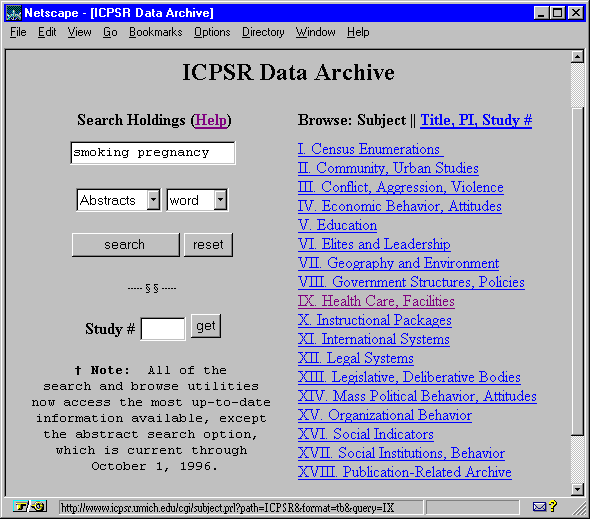
homepage. A page will appear that allows you to browse or search the holdings.
To browse the holdings, select a particular categorization (e.g., "Health Care,
Facilities"). To search the holdings supply one or more keywords or strings in
the Search Holdings dialog box. Note that you have the option of searching
Titles (default), Principal Investigators, or Abstracts for the keywords you specify.
You can also search by string or word. The following search rules apply:
From the list of holdings that match your search criteria, you can view
the abstract (designated as "AB" on the page) for more information. The
abstract includes for example the investigator, a summary, and information
about the study such as when data was collected, sampling design, the
number of records, and the data collection methodology. Note that the
abstract can be printed within the browser.
The following illustrates a search of the abstracts in the archives
for the keywords "smoking" AND "pregnancy". The following page contains
the results of the query.
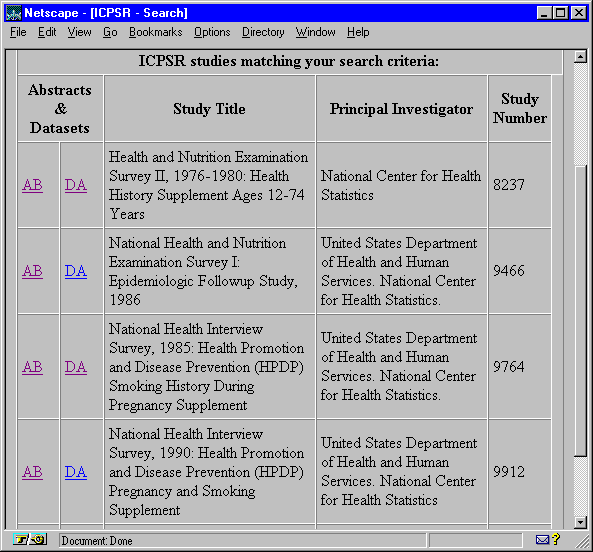
In order to view more information about any particular study, click on "AB"
to view an abstract. The abstract for the "NATIONAL HEALTH INTERVIEW
SURVEY, 1990: HEALTH PROMOTION AND DISEASE PREVENTION (HPDP)
PREGNANCY AND SMOKING SUPPLEMENT" is presented below.
STUDYNO = 09912;
INVESTIGATOR = United States Department of Health and Human Services. National
Center for Health Statistics.;
TITLE = NATIONAL HEALTH INTERVIEW SURVEY, 1990: HEALTH
PROMOTION AND DISEASE PREVENTION (HPDP) PREGNANCY AND
SMOKING SUPPLEMENT;
SUMMARY = The basic purpose of the National Health Interview Survey (NHIS) is to
obtain information about the amount and distribution of illness, its effects in terms of
disability and chronic impairments, and the kinds of health services people receive. The
purpose of this supplement was to estimate women's current smoking practices and to
measure knowledge of the effects of cigarette smoking on certain health problems,
pregnancy, and childbirth. The file contains approximately 90 variables from the core file
(see NATIONAL HEALTH INTERVIEW SURVEY, 1990 [ICPSR 9839]), including
sex, age, race, marital status, veteran status, education, income, industry and occupation
codes, and limits on activity. Variables unique to this supplement include questions on
current pregnancy status, whether the respondent had ever smoked 100 cigarettes, whether
she currently smoked, time elapsed since the respondent last smoked regularly, number of
cigarettes the respondent smoked per day, whether the respondent smoked during
pregnancy, number of cigarettes smoked before learning of pregnancy, number of
cigarettes smoked after learning of pregnancy, whether the respondent smoked during most
of their last pregnancy, and whether the respondent was ever advised by a doctor to quit
smoking.;
SERIES.INFO = The National Health Interview Surveys (NHIS), a continuous sampling
and interviewing of the civilian, noninstitutionalized population of the United States, contain
information on the social, demographic, and economic aspects of illness, disability, and
medical services. Information on the utilization of medical care facilities is also available in
the form of data on medical and dental care, hospitalization, preventive care, nursing care,
prosthetic appliances, and self-care. The National Health Interview Surveys are the primary
instrument of a major National Center for Health Statistics (NCHS) data collection
program.;
DATE.OF.COLLECT = 1990;
DATA.SOURCE = personal interviews;
COLLECT.NOTE = Per agreement with NCHS, ICPSR distributes the data file(s) and
technical documentation in this collection in their original form as prepared by NCHS. The
age distribution is 18-24 years (N = 5,889), 25-34 years (N = 10,633), and 35-44 years
(N = 9,317). The racial/ethnic distribution is White (N = 20,214), Black (N = 4,130),
Asian/Pacific Islander (N = 702), Native American (N = 206), multiple (N = 17), and
other or unknown (N = 570).;
SAMPLING = The NHIS uses a multistage probability sampling design. Four independent
representative samples, which may be used in any combination, were drawn. Black
persons were oversampled.;
UNIVERSE = Civilian noninstitutionalized population of the 50 states and the District of
Columbia.;
RELATED.PUBS = United States Department of Health and Human Services. National
Center for Health Statistics. ''Current Estimates From the National Health Interview
Survey, 1990.'' VITAL AND HEALTH STATISTICS, Series 10, No. 181. DHHS
Publication No. (PHS) 92-1509. Public Health Service. Washington, DC: United States
Government Printing Office, October 1991.;
RELATED.PUBS = United States Department of Health and Human Services. National
Center for Health Statistics. ''Design and Estimation for the National Health Interview
Survey, 1985-1994.'' VITAL AND HEALTH STATISTICS, Series 2, No. 110. DHHS
Publication No. (PHS) 89-1384. Public Health Service. Washington, DC: United States
Government Printing Office, August 1989.;
Accessing and Searching the Archives via ICPSR’s Gopher Site
To access the gopher site on Pitt’s VMS timesharing service,
connect to VMS and type the following at the VMS prompt:
$ gopher gopher.icpsr.umich.edu
After connecting to the ICPSR gopher site, select the following menu items:
Archival Holdings of the ICPSR
Search the Guide to ICPSR Machine-Readable Data Holdings
You then supply a search string (e.g., smoking) and view a list of matching
holdings. An abstract for the holding can be obtained by selecting an
item from the list. Note that WEB access is preferred as it is easier to use.
Obtaining the Data and a Codebook
The data can only be obtained from an authorized representative
from the University of Pittsburgh. The membership is maintained by
Computing and Information Services and the current representatives are
Phil Sidel (648-7384) and Li Tong (648-7381). They can also be reached
via email at the account ARCHIVES@VMS.CIS.PITT.EDU. In order to
request a dataset, the title and study number (available in the abstract) is
required. The data will be obtained locally or via FTP from ICPSR
usually within one week. These individuals can also help with reading the
datasets using statistical software.