
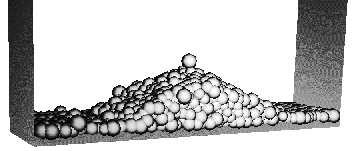
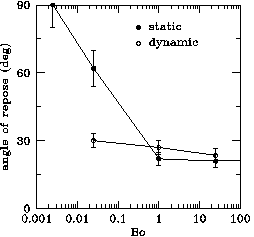
- Computer simulation of heap formation both with and without
cohesion. As expected, cohesive effects become important near Bo~1
(i.e., when the cohesive force between the particles is roughly equal
to the particle weight). The static angle increases markedly with Bo <
1 (i.e., cohesive force > particle weight), while the dynamic angle --
obtained in a rotated tumbler -- remains relatively flat (the angle
increases for Bo > 1 and decreases for Bo <
1).
Many of the industries which deal with particulate materials are in some way affected by cohesion; most notably the pharmaceutical, metallurgical, and pigment industries. Cohesion between particles arises from a variety of sources: van der Waals forces, electrostatic forces, and liquid bridging (capillary forces), to name a few. These interparticle forces become increasingly important as particle size decreases and, as cohesion becomes important, substantial departure from the behavior of free-flowing particulate systems becomes evident. For the case of free-flowing powders, it is necessary to attempt to restrict particle motion in order to minimize segregation or de-mixing. In contrast, in cohesive systems, particles tend to segregate into aggregates that must be broken apart to attain a quality mixture. Despite this fundamental difference, some of the tools that have proven effective for the study of cohesionless materials can still be employed for cohesive systems -- specifically, particle dynamics simulations. To that end, a cohesive-solid particle dynamics code is being developed to study the change in stable heap angle as a function of global Bond number (the ratio of particle weight to attractive force) as well as the evolution of mixing in a rotated drum. Here, we are concerned with moderately sized particles, ~1mm, and so we devote our attention to the forces attributable to interstitial liquid -- the dominant interaction effect at these length scales.
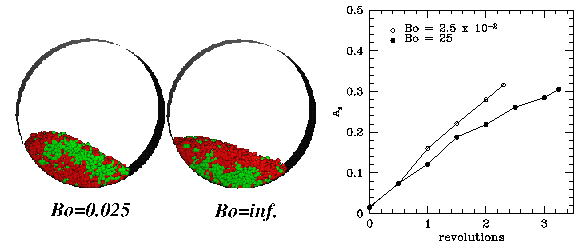
- A comparison of mixing at different Bo numbers. At left is a
qualitative comparison, after 2 revolutions, of the mixing within a
drum at different Bo numbers. A quantitative measure, based on the
interfacial area As, is plotted as a function of revolutions at right.
Note that the mixing rate for Bo = 0.025 is faster.