
The following problems are to help you sharpen and deepen your understanding of the molecular basis of mutation and the isolation and identification of mutant individuals. We will discuss these questions in the recitation section on Oct. 31 Problems are not to be handed in and will not be graded.
1. Certain kinds of mutational events lead to rearrangements of the genes on a chromosome. Consider the following:
The inversion has the properties of a "dominant crossover suppressor", because in an individual with one inversion chromosome and one normal chromosome, crossing-over between genes A and E is strongly reduced. [We skipped over this subject in Chap. 6. Read it if the subject of chromosomal rearrangements interests you.] See if you can work out an explanation of why such an inversion suppresses crossing-over.
2. In the nematode C. elegans, a rearrangement called C1 is a dominant crossover suppressor on chromosome II. You construct an individual of the following genotype:
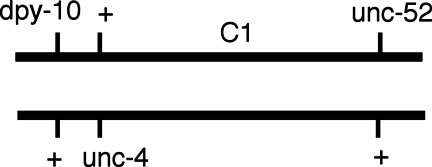
The indicated mutant alleles of unc-4, unc-52 and dpy-10 are all recessive, so the genotype above produces wild-type phenotype. Individuals homozygous for unc-52 are paralyzed, whereas individual homozygous for unc-4 are "kinky" (do not crawl smoothly). Remember, this nematode is normally a self-fertilizing hermaphrodite. You treat these individuals with a mutagen (EMS is normally used) and place single wild-type F1 individuals on separate growth plates.
a) What phenotypes do you expect to see in the next (F2) generation if no additional mutations have been induced on either chromosome II homolog?
b) What phenotypes do you expect to see in the F2 generation if a lethal mutation linked to unc-4 has been induced? How would you identify individuals carrying this lethal mutation?
c) What is the reason for using the C1 crossover-suppressor in this experiment? [Consider what would happen if it were not present.]
3. It has long been observed that DNA-alkylating agents preferentially induce mutations at DNA replication forks. In light of your knowledge of how alkylating agents induce mutations, explain why this might be so.
4. DNA-alkylating agents such as EMS ethylate G so that O-ethyl-G mispairs with T rather than the normal C. They also ethylate T so it mispairs with G. Draw chemical structures to indicate how each of the following mutations occur after EMS treatment:
and show why you cannot get
Return to Honors Genetics Main Page