Notes · exotic hadrons
Di-J/ψ Structure Without Tetraquarks
The bumps and dips in the LHC's J/ψ-pair spectrum are usually read as new four-quark particles. Here they come out of ordinary charmonium pairs bouncing off each other after they are made.
1The puzzle
In 2020 LHCb measured the mass spectrum of J/ψ pairs produced in proton–proton collisions. Above threshold it found a broad enhancement, a dip near 6.75 GeV, a narrow peak near 6.9 GeV and a hint of more structure near 7.2 GeV. ATLAS and CMS confirmed the pattern.
CMS describes its spectrum with three interfering resonances, \(X(6600)\), \(X(6900)\) and \(X(7100)\), and reads them as excitations of a \(cc\bar c\bar c\) tetraquark. Most theoretical work also assigns the structures to states.
2The idea: rescattering
Two gluons make a compact \(cc\bar c\bar c\) lump. Before it is detected as two J/ψ, the four quarks can rearrange into other charmonium pairs, such as J/ψ ψ(2S) or \(\chi_{cJ}\chi_{cJ'}\), and back again. Each time a new pair channel opens, it pulls flux out of J/ψ J/ψ, which leaves a dip, and the interference between these paths leaves peaks between the dips.
- Quark model. The charm-quark Hamiltonian (Coulomb plus linear confinement plus hyperfine term) is fixed by the charmonium spectrum. Nothing in it is tuned to the di-J/ψ data.
- Meson–meson force. Colour-singlet mesons interact by swapping quarks. The quark-exchange kernels come from the same Hamiltonian, and the coupled-channel scattering is solved to all orders with a variational resonating-group method.
- Channels. Ten \(J^{PC}=2^{++}\) S-wave channels, from J/ψ J/ψ up to J/ψ ψ(4S).
To compare with data, the model supplies only the distortion \(E(M)\) of the J/ψ J/ψ rate. The undistorted continuum shapes come from LHCb's templates for single-parton (SPS) and double-parton (DPS) scattering:
\[ \begin{equation} \frac{dN}{dM} = \big[a\,E(M) + c\big]\,N_{\rm SPS}(M)\,e^{-\lambda (M - 6.2\,{\rm GeV})} + N_{\rm DPS}(M). \label{eq:fit} \end{equation} \]That leaves three background parameters, \(a\), \(c\) and \(\lambda\). The positions and sizes of the features are not adjustable.
rescattering.mp4 · 0.2 MB
| Stage in Figure 1 | χ² / 50 |
|---|---|
| Single-parton continuum only | 1018 |
| + double-parton scattering | 109 |
| + rescattering, J/ψ J/ψ only | 156 |
| + J/ψ ψ(2S) | 117 |
| + \(\chi_{cJ}\chi_{cJ'}\) and \(h_c h_c\) | 91 |
| + J/ψ ψ(3S) | 71 |
| + ψ(2S) ψ(2S) | 65 |
| + J/ψ ψ(4S): all ten channels | 61 |
3What it gets right, and wrong
Fitting only the three background parameters gives χ²/ndf = 56/50 for LHCb and 117/55 for CMS (which gets its own background). The model produces:
- the broad enhancement near 6.5 GeV, in the \(X(6600)\) region, from the elastic J/ψ J/ψ interaction;
- the dip near 6.8 GeV, where flux leaks into J/ψ ψ(2S);
- the peak near 6.9 GeV, the would-be \(X(6900)\), that follows the dip;
- a peak in the J/ψ ψ(2S) spectrum near 6.8 GeV, which CMS sees. One mechanism makes a dip in one channel and a peak in the other.
It falls short in places: the 6.9 GeV peak is 15–20% low, CMS's dips are deeper than the model's, there is no enhancement near 7.2 GeV, and the model has a small bump at the ψ(2S)ψ(2S) threshold (7.4 GeV) that the data do not show.
The amplitude does have poles, near 6.81 and 7.10 GeV. They come from the shape of the quark-exchange force (repulsive at low momentum, attractive at high), not from bound four-quark states, so they should not be read as tetraquarks.
The di-J/ψ structures can be understood as rescattering of charmonium pairs made by a compact source, with no tetraquark resonances required.
4A prediction for Υ pairs
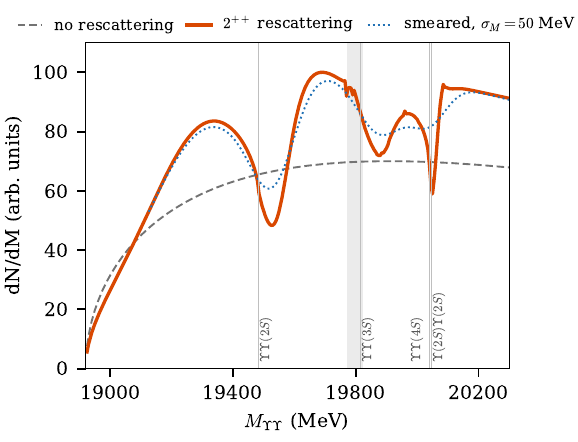
The same mechanism should shape the spectrum of Υ(1S) pairs. Refitting the quark model to thirteen bottomonium levels and rerunning the ten analogous channels gives the curve in Figure 2. The Υ-pair spectrum shape has not yet been measured.
5Where it sits in the literature
Figure 3 maps the paper's 47 references by topic and date. A line joins two references when one cites the other (data from INSPIRE). Hover over a dot to see what it cites and what cites it. Click or tap a dot to go one layer further back: that paper's own references open in a lane below the map. The dark square at the top right shows this paper's links to all 47.
List of references by topic
6The paper
When hadrons collide: di-J/ψ structure in the final state
E. S. Swanson, University of Pittsburgh · arXiv:2610.15248 [hep-ph] (2026) · PDF