Research · gluonic matter
One Model for Gluonic Hadrons
A single set of rules for quarks and gluons, fixed on ordinary charmonium, then asked to predict hybrids, glueballs and gluelumps.
Preview of early work. This page shows work in progress, before publication. The model, its parameters and every number and figure here may change. Please cite as C. Farina and E. S. Swanson, in progress.
1The question
Protons, pions and the other hadrons are made of quarks held together by gluons. In most hadrons the gluons only provide the glue. But QCD, the theory of quarks and gluons, also allows hadrons in which the gluons themselves carry energy and angular momentum:
- Hybrids: a quark and an antiquark plus an excited gluon. Some hybrids have quantum numbers \(J^{PC}\) that no quark–antiquark pair can have. These "exotic" states are the clearest sign of gluonic excitation, and experiments such as GlueX at Jefferson Lab search for them.
- Hybrid baryons: three quarks plus an excited gluon.
- Glueballs: hadrons made of gluons alone.
- Gluelumps: a gluon bound to an infinitely heavy colour source, a clean laboratory for how a gluon moves.
Lattice QCD, which solves the theory numerically on a space–time grid, now gives the masses of all of these. Models are usually built for one kind of hadron at a time. The aim here is to describe all of them with one Hamiltonian and one set of parameters, so that each new sector is a test rather than a new fit.
2The model in brief
The starting point is QCD in Coulomb gauge. There the gluon field splits into an instantaneous Coulomb-like force and transverse gluons. The transverse gluons behave like particles with an energy \(\omega(k)\) that depends on their momentum \(k\); they are called quasigluons or constituent gluons. A hadron is then a small number of heavy quarks and quasigluons with the Hamiltonian
where \(E\) is the lowest (or an excited) energy of \(H\) and \(M\) the hadron mass. The pair potentials \(V_{ij}\) contain a short-distance Coulomb part from one-gluon exchange, a linear confining part with string tension \(b\), and spin-dependent terms. They act between every pair: quark–quark, quark–gluon and gluon–gluon. Each is multiplied by a colour factor that depends on how the pair's colours combine, which is what lets one rule cover mesons, baryons, hybrids and glueballs.
Two forms of the gluon energy are tried, and each is used everywhere in the model:
Option 1 gives the gluon an effective mass at low momentum. Option 2 is the form proposed by Gribov and found in Coulomb-gauge studies of QCD; it grows without limit at small \(k\), so long-wavelength gluons cost a lot of energy.
| Parameter | Meaning | Option 1 | Option 2 |
|---|---|---|---|
| \(\alpha_s\) | strong coupling | 0.410 | 0.416 |
| \(b\) | string tension (GeV²) | 0.157 | 0.156 |
| \(m_c\) | charm-quark mass (GeV) | 1.390 | 1.390 |
| \(\sigma\) | smearing scale of the one-gluon terms (GeV) | 1.247 | 1.299 |
3How it is tested
The four parameters of Table 1 are fitted to 20 charmonium (\(c\bar c\)) levels from lattice QCD. After that nothing is refitted, apart from one overall constant per gluonic sector. This constant absorbs the poorly known rest energy of the gluon; it moves a whole spectrum up or down but cannot change the spacing between its levels. So the pattern of levels in each new sector is a prediction.
The equations are solved numerically, with each hadron's wave function expanded in Gaussian functions of the particle separations and the best combination found by diagonalising \(H\) (the Rayleigh–Ritz method).
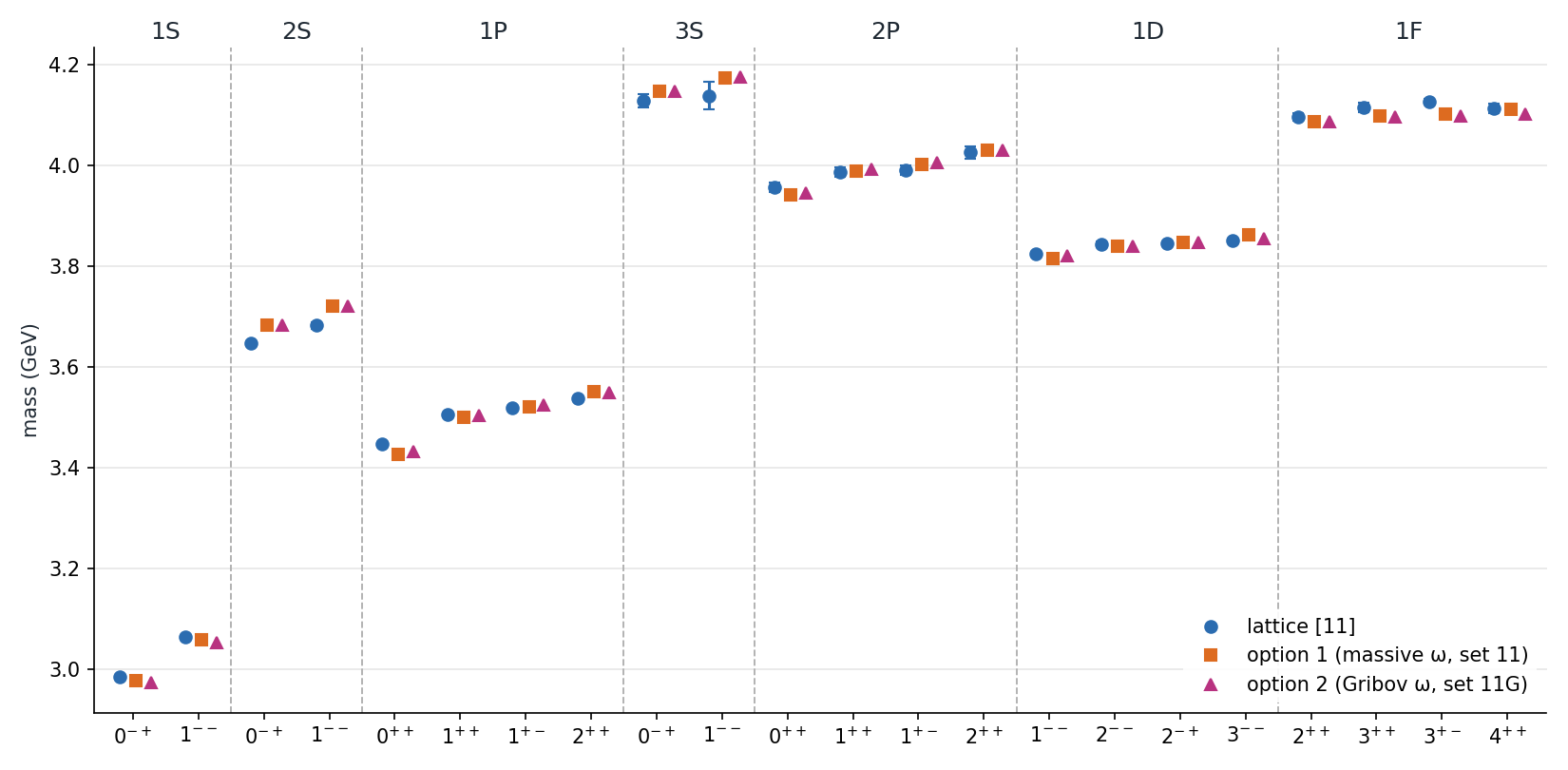
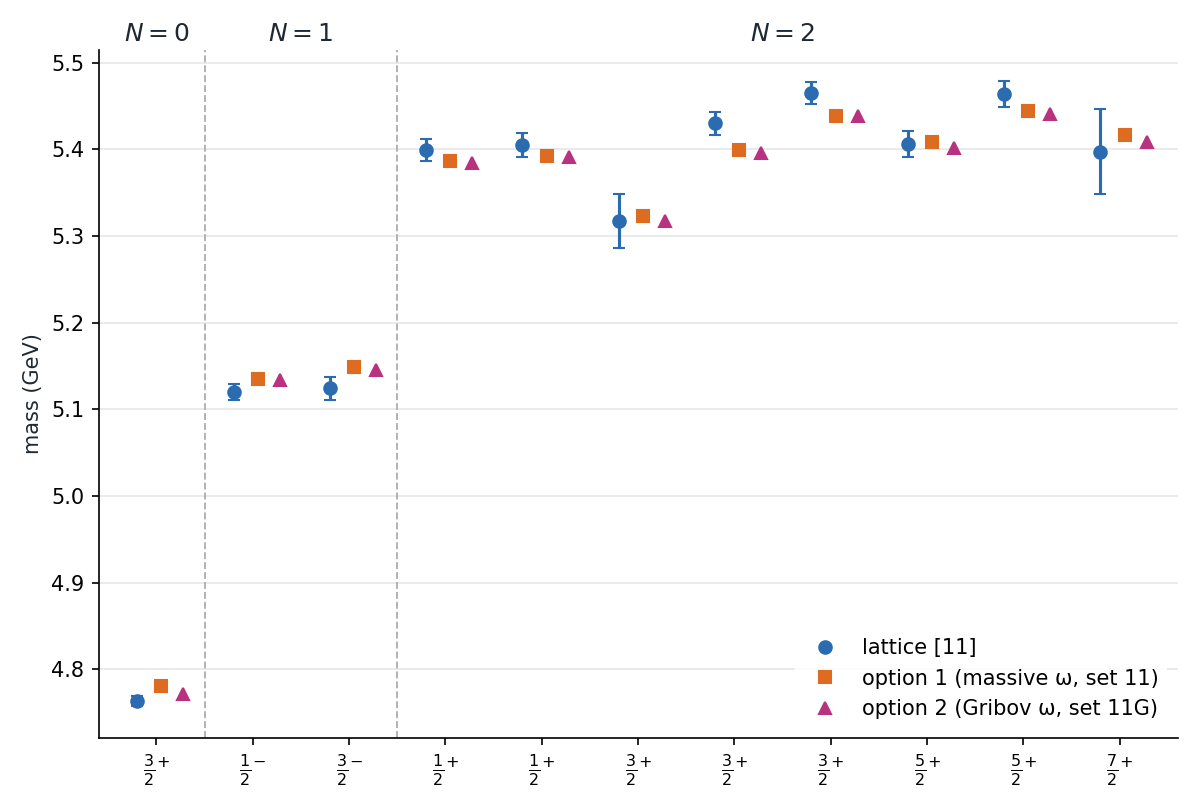
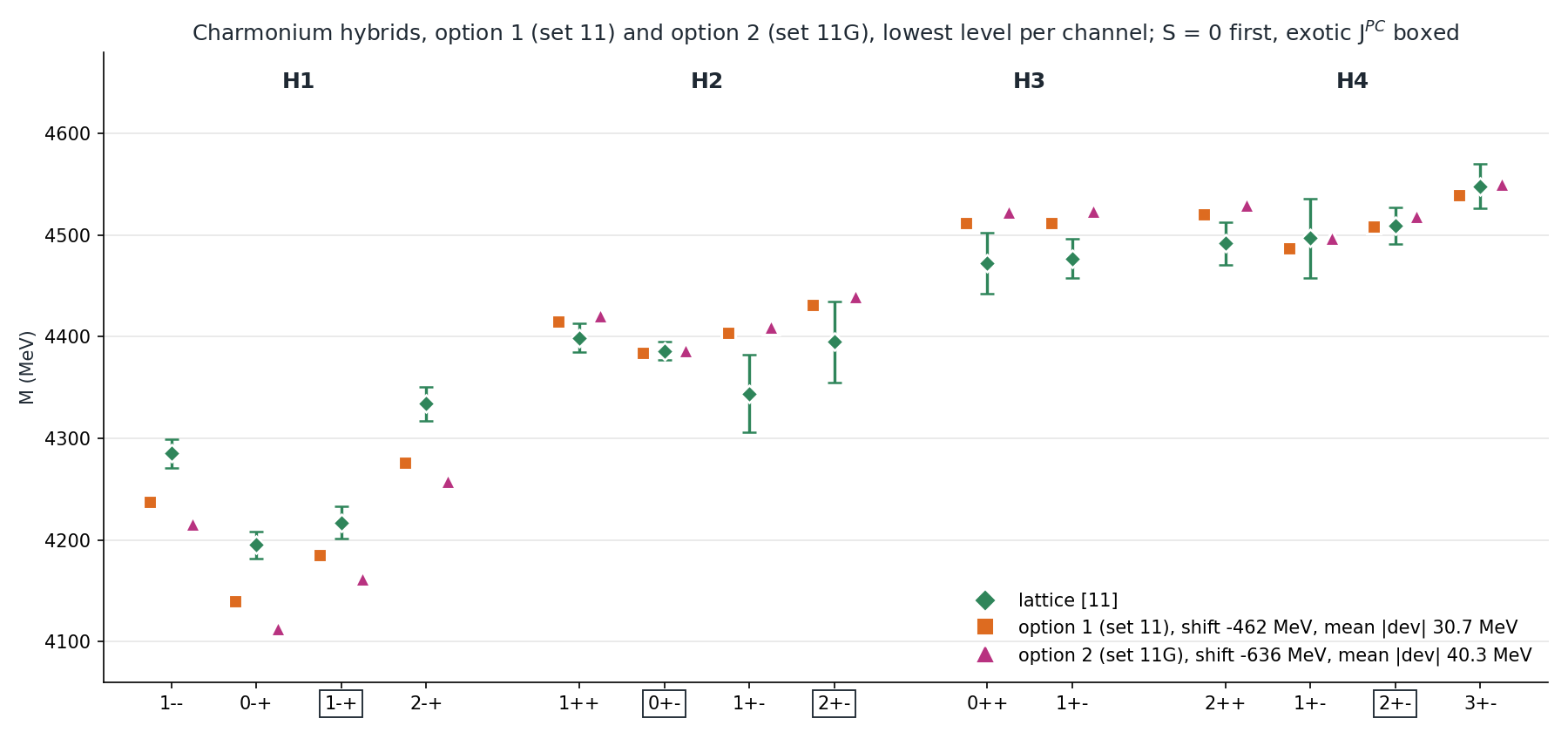
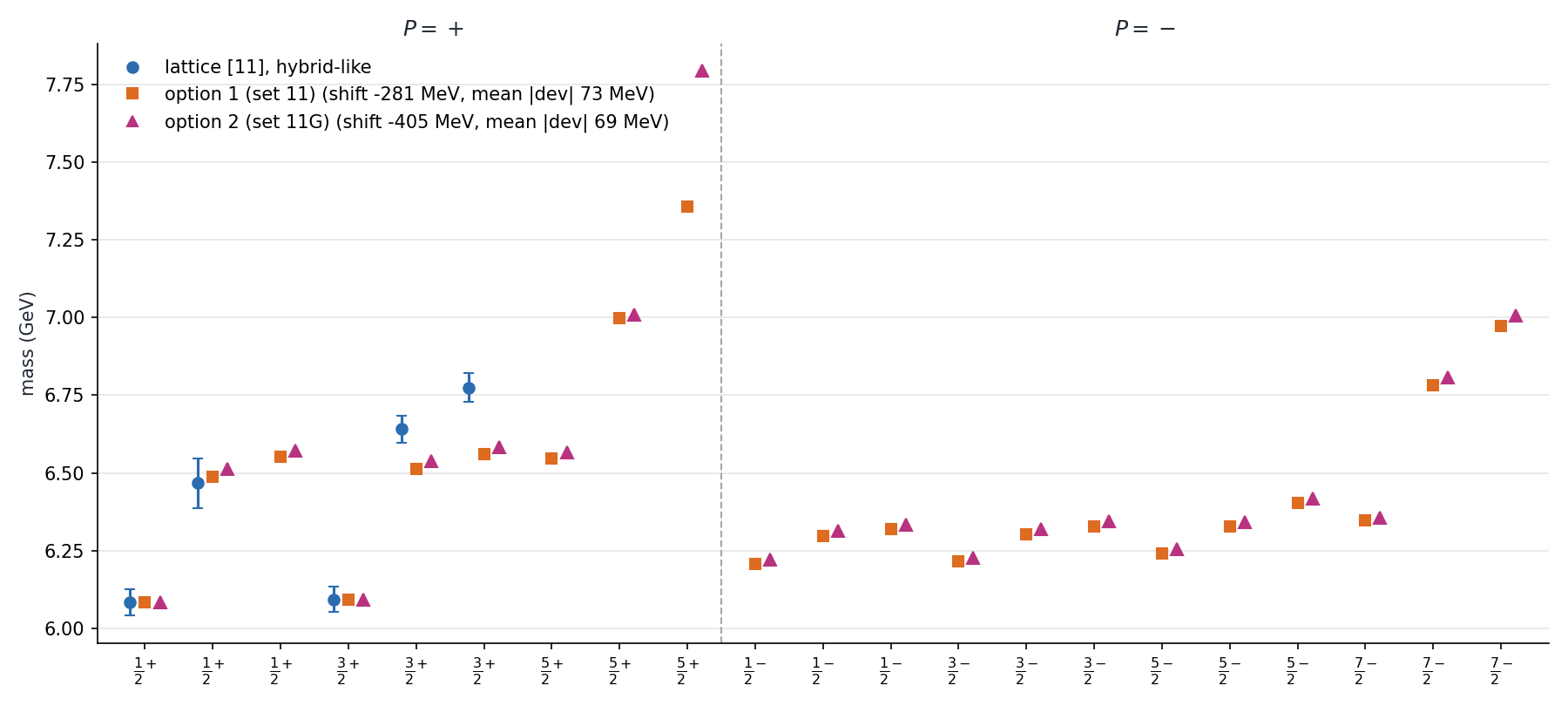
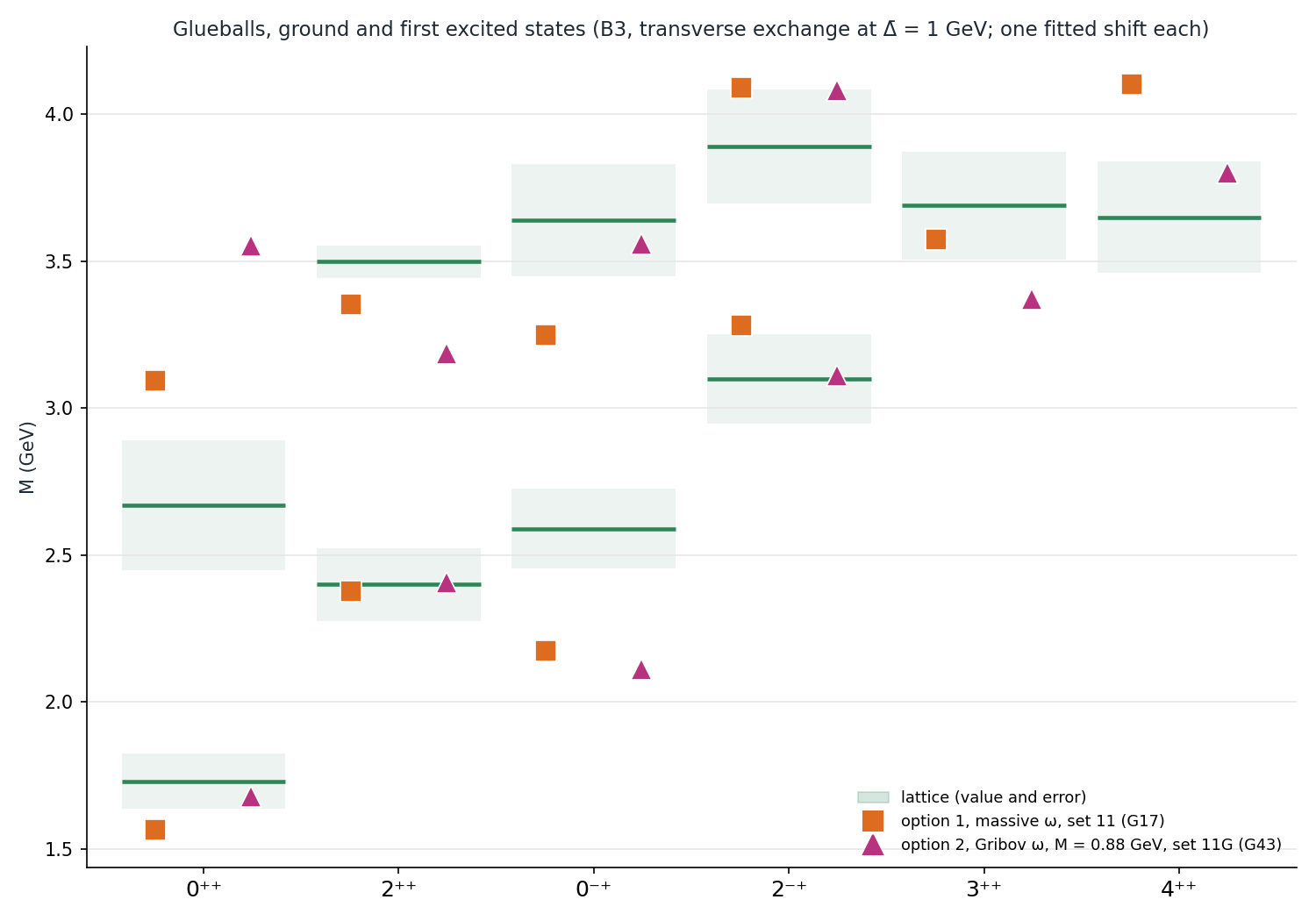
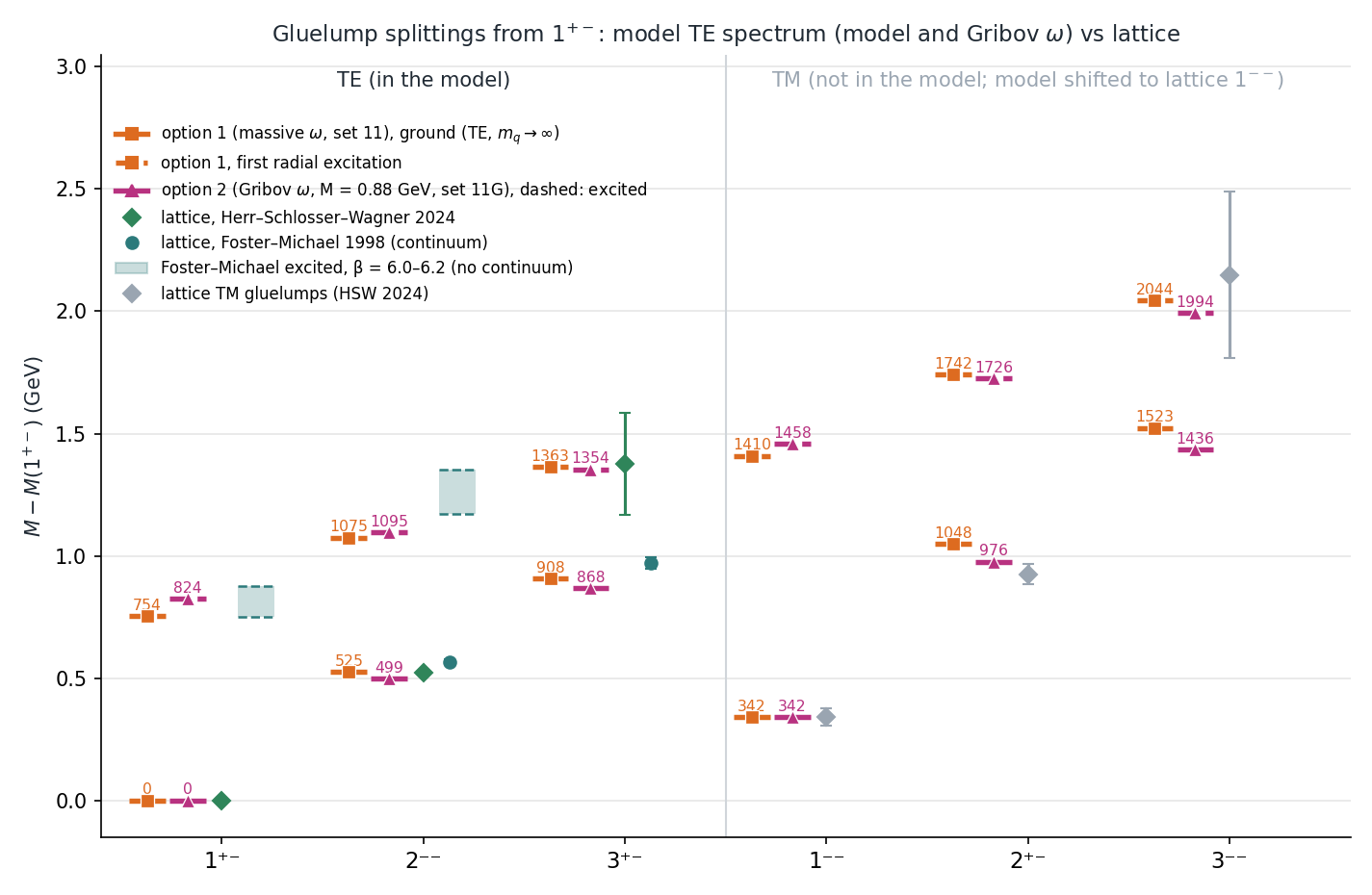
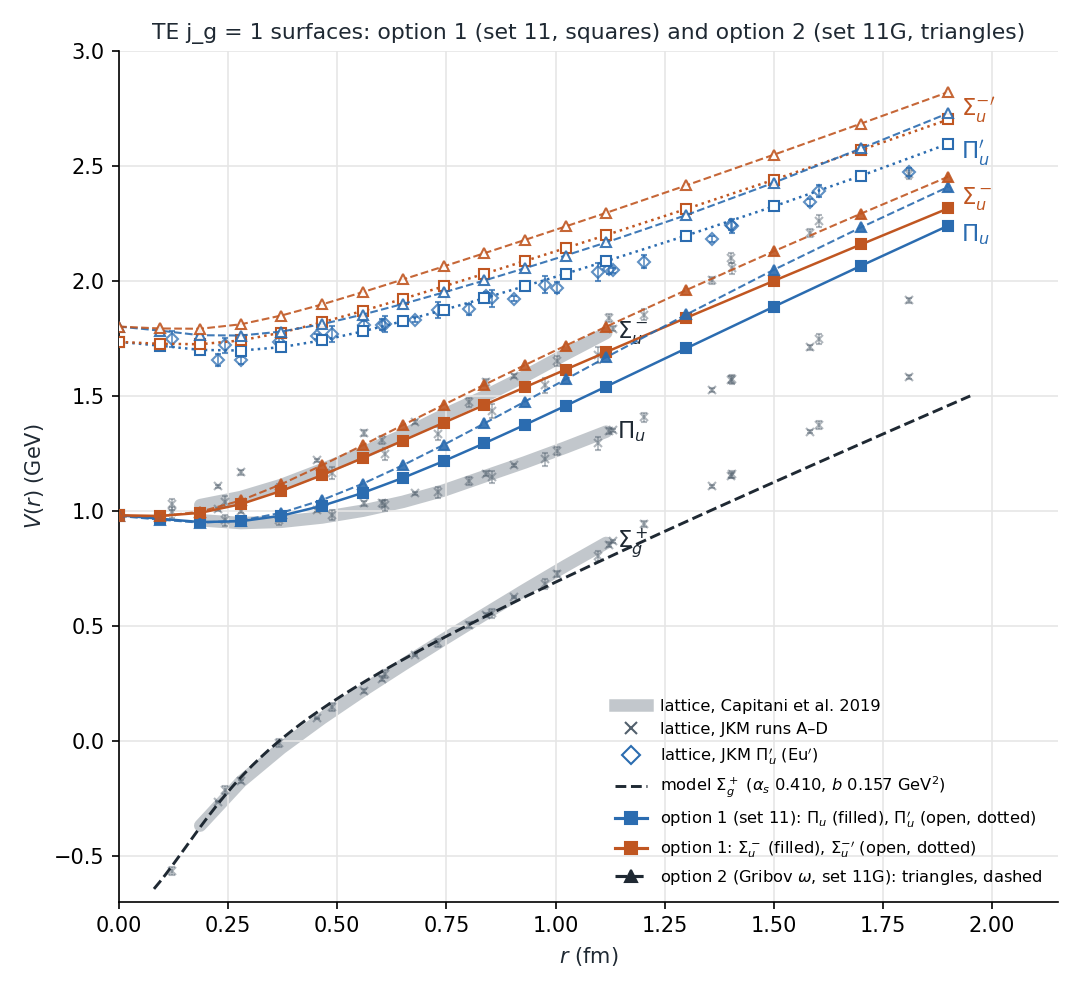
In every figure below, orange squares are option 1, magenta triangles are option 2, and the lattice results are shown with their errors.
4Charmonium and Ωccc
Charmonium is where the model is fitted, so Figure 1 shows how well the fit works: 22 levels from 1S to 1F, with an average deviation of 13 MeV. The triply charmed baryon \(\Omega_{ccc}\) (Figure 2) is the first test: three charm quarks with the same interaction, now with the colour factor of a baryon.
5Hybrids
Add one gluon to charmonium and you get the charmonium hybrids. The lattice finds them in groups (labelled H1 to H4 in Figure 3), and the model reproduces this grouping and the order of the groups. The boxed channels are exotic: they cannot be made from a charm quark and antiquark alone. Figure 4 does the same for hybrid baryons, three charm quarks plus a gluon.
6Glueballs, gluelumps and hybrid potentials
The last three tests remove the quarks, or make them infinitely heavy. Glueballs (Figure 5) are two quasigluons bound together; this is the hardest test, and the deviations are largest here. Gluelumps (Figure 6) are one gluon held by a fixed colour source. The static hybrid potentials (Figure 7) are the energy of the gluon field between a fixed quark and antiquark as the distance \(r\) between them grows; in the usual picture of heavy hybrids, the quark and antiquark then move in these potentials.
7Citation and lattice data
C. Farina and E. S. Swanson, in progress.
Earlier work on the Coulomb-gauge constituent picture: A. P. Szczepaniak and E. S. Swanson, "Coulomb gauge QCD, confinement, and the constituent representation", Phys. Rev. D 65, 025012 (2001), hep-ph/0107078.
Lattice QCD results compared with:
- L. Liu et al., "Excited and exotic charmonium spectroscopy from lattice QCD", JHEP 07, 126 (2012), arXiv:1204.5425.
- M. Padmanath, R. G. Edwards, N. Mathur and M. Peardon, "Spectroscopy of triply-charmed baryons from lattice QCD", Phys. Rev. D 90, 074504 (2014), arXiv:1307.7022.
- C. J. Morningstar and M. J. Peardon, "The glueball spectrum from an anisotropic lattice study", Phys. Rev. D 60, 034509 (1999), hep-lat/9901004.
- H. B. Meyer and M. J. Teper, "Glueball Regge trajectories and the pomeron: a lattice study", Phys. Lett. B 605, 344 (2005), hep-ph/0409183.
- J. Herr, C. Schlosser and M. Wagner, "Gluelump masses and mass splittings from SU(3) lattice gauge theory", Phys. Rev. D 109, 034516 (2024), arXiv:2306.09902.
- M. Foster and C. Michael, "Hadrons with a heavy color adjoint particle", Phys. Rev. D 59, 094509 (1999), hep-lat/9811010.
- S. Capitani et al., "Precision computation of hybrid static potentials in SU(3) lattice gauge theory", Phys. Rev. D 99, 034502 (2019), arXiv:1811.11046.
- K. J. Juge, J. Kuti and C. Morningstar, "Fine structure of the QCD string spectrum", Phys. Rev. Lett. 90, 161601 (2003), hep-lat/0207004.