Outreach · an introduction to particle physics
Constructing the Universe: the Particle Explosion
What is the universe made of, and how do we know? A tour from the Greek atomists to quarks, gluons and the Standard Model: the people, the experiments and the machines.
1The ancients
The Greeks laid down some of the founding ideas of physics: that matter is conserved, and that it is made of atoms. Few new ideas followed for many centuries. Then the Renaissance brought a new insistence on observation, and Copernicus and others began to replace Greek doctrine with theories tested against the world. Copernicus ended the old era as much as he began the new, so he belongs with the ancients.
- 624–547 BCThales of Miletus holds that water is the basic substance of the Earth. He knows the attractive power of magnets and of rubbed amber.
- 580–500 BCPythagoras teaches that the Earth is a sphere, and seeks a mathematical understanding of the universe.
- 500–428 BC, 484–424 BCAnaxagoras argues that matter is never created or destroyed, only rearranged as indivisible particles, a forerunner of the conservation of matter. Empedocles reduces everything to four elements: earth, air, fire and water.
- 460–370 BCDemocritus: the universe is empty space and a vast number of invisible, indivisible particles, atoms, differing in form, position and arrangement.
- 384–322 BCAristotle organises the gathering of knowledge; his compilation is the basis of science for a thousand years.
- 310–230 BCAristarchus puts the Sun at the centre, as Copernicus would 1,800 years later. Against Aristotle's authority, the idea is rejected.
- 287–212 BCArchimedes founds hydrostatics, the physics of fluids at rest.
- c. 100–170 ADPtolemy of Alexandria collects the optics of his day and builds an elaborate theory of planetary motion.
- c. 1000 ADIbn al-Haytham (Alhazen) writes seven books on optics.
- c. 1219–1292Roger Bacon teaches that to learn nature's secrets we must first observe it.
- 1473–1543Nicolaus Copernicus sets out a universe in which the Earth goes round the Sun, overturning the authority of Aristotle.
The four elements, and others
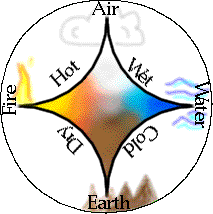
The diagram shows Aristotle's arrangement: each element combines two of the qualities hot, cold, wet and dry.
Other traditions counted differently. In China the five phases (wu xing) were earth, wood, metal, fire and water. In India the Sāṃkhya-kārikā of Īśvarakṛṣṇa (about the 3rd century AD) lists five gross elements: space, air, fire, water and earth.
2Dawn of the modern era
The electron
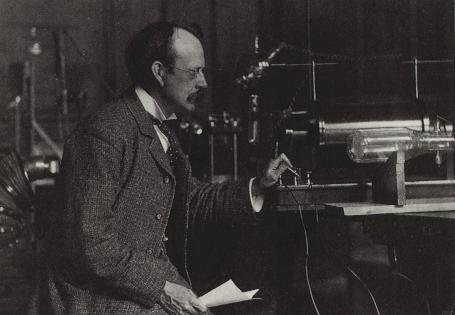
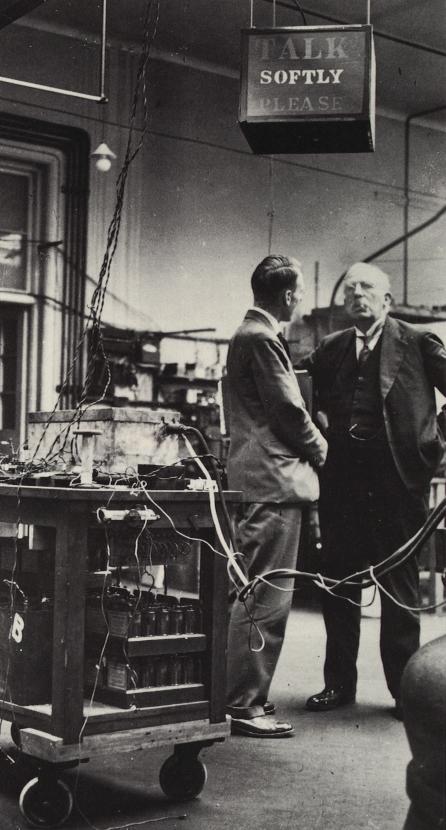
In 1897 J. J. Thomson, professor of physics at Cambridge, showed that cathode rays are streams of negatively charged particles about 2,000 times lighter than a hydrogen atom, and boldly asserted that these particles are in all matter. Something smaller than the lightest atom was part of the building of matter. He won the Nobel Prize in 1906. With a young student, Ernest Rutherford, Thomson also studied how the newly discovered X-rays ionise gases.
Radioactivity
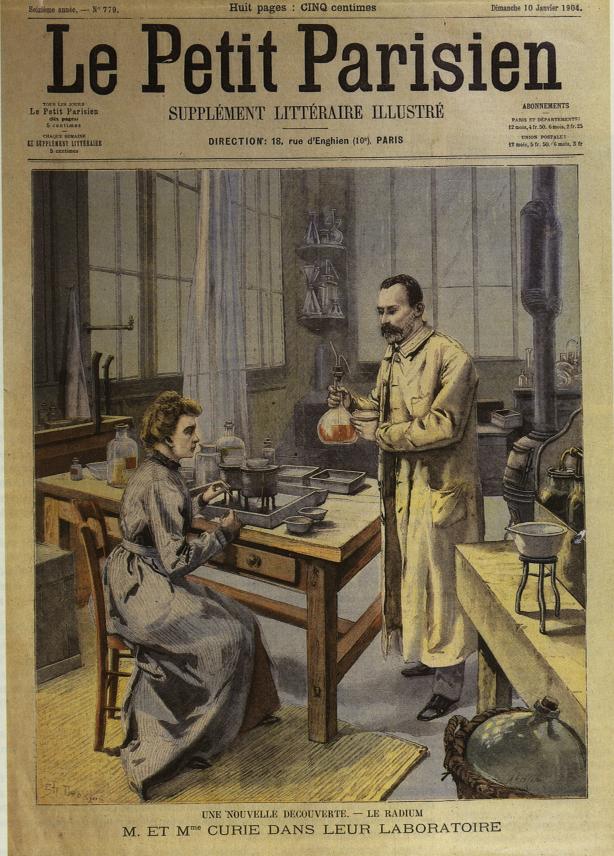
In 1896 Henri Becquerel found that uranium salts give off rays that fog photographic plates. Marie Curie (born Maria Skłodowska) and Pierre Curie went on to isolate two new, far more active elements, polonium and radium.
The nucleus
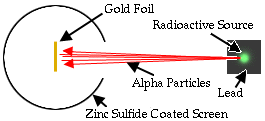
Rutherford, with Hans Geiger and Ernest Marsden, put radioactivity to work. They fired alpha particles (helium nuclei: two protons and two neutrons) at a thin gold foil. Most passed straight through, but a few bounced back, which could only mean that the atom's positive charge and almost all its mass sit in a tiny core: the nucleus.
Fission
In 1939 Frédéric Joliot showed that neutrons are released when uranium nuclei split, the step that makes a chain reaction possible.

"If, as I have reason to believe, I have disintegrated the nucleus of the atom, this is of greater significance than the war."
3The atom
Plum pudding
In 1904 Thomson suggested that atoms, and so all matter, are negative electrons embedded in a sphere of positive charge, like plums in a pudding.
The nuclear atom
Rutherford's scattering experiments showed in 1911 that Thomson's model was, in Rutherford's words, "not worth a damn". The atom is a diffuse cloud of negative charge around a tiny, positively charged nucleus. In 1920 he made a remarkably bold further claim: a new, neutral particle must live in the nucleus alongside the protons. James Chadwick found the neutron in 1932. Rutherford's picture of the atom is essentially correct, and it crowns the atomic model of matter, arguably the most important and pervasive idea people have ever had. Asked what humanity's greatest achievement was, to put on a spacecraft, Carl Sagan is said to have answered: the atomic paradigm.
Bohr's atom
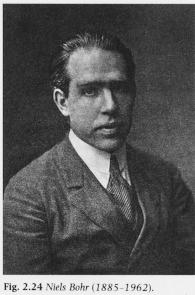
In 1913 Niels Bohr took the next step, combining Rutherford's atom with Planck's and Einstein's quantum ideas: electrons may occupy only certain orbits, and light is emitted when they jump between them. The theory was incomplete and in places wrong, but its basic ideas survive.
Quantum atoms
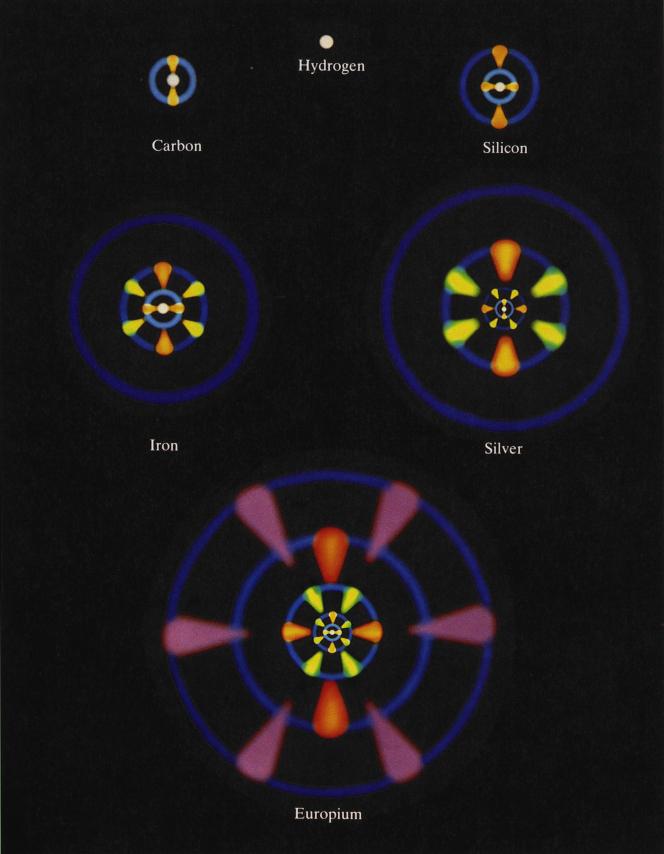
The modern picture of the atom rests on the quantum mechanics of Erwin Schrödinger and Werner Heisenberg, worked out in 1925–26. It describes the electronic structure of every element, and with it all of chemistry.
4"Who ordered that?"
Visitors from space
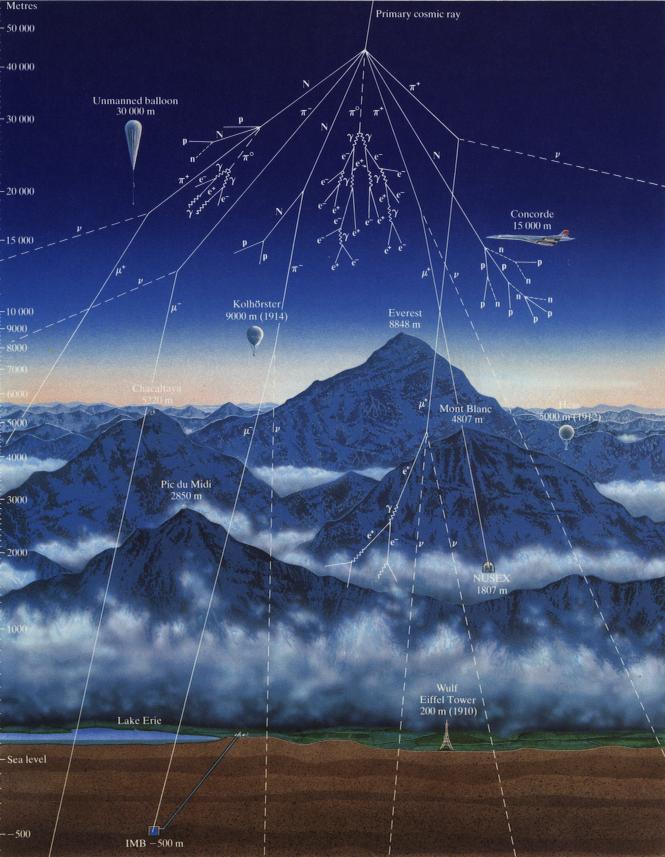
A constant shower of cosmic rays, energetic photons, protons and atomic nuclei, rains into the Earth's atmosphere from space. The first clue came in 1910, when Father Theodor Wulf, a Jesuit priest, carried an electrometer up the Eiffel Tower and measured more radiation than he expected. Victor Hess followed up in 1912 by taking instruments up in balloons: the radiation grew stronger the higher he went, strong evidence that it comes from outside the Earth. He shared the Nobel Prize in 1936.
Antimatter
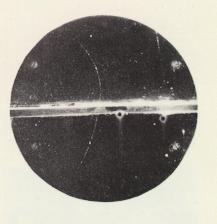
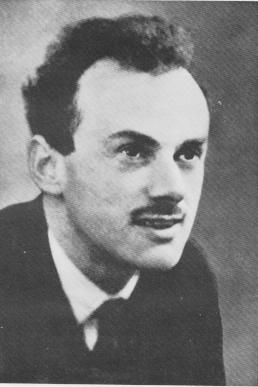
In 1930 Robert Millikan asked his student Carl Anderson to build a cloud chamber to study cosmic rays. In a strong magnetic field the tracks curve, one way for positive charges and the other for negative, and Anderson found positive and negative particles in about equal numbers. Millikan thought the positive ones were protons; Anderson thought they were electrons travelling upwards, having come through the Earth. He settled the argument with a thin lead plate across the chamber: a particle loses energy in the lead, so its track curves more tightly afterwards, revealing which way it was going. Both men were wrong: the positive tracks were made by particles with the mass of the electron but the opposite charge. In 1932 Anderson had found the positron, the first antiparticle, predicted by Paul Dirac in 1928.
How a magnetic field reveals the charge
A magnetic field B pushes on a charge q moving with velocity v with the force
F = q v × B, |F| = q |v| |B| sin φ
where φ is the angle between v and B. The force is at right angles to the motion, so the path curves, and it curves the opposite way for opposite charges. If v points up and B to the right, a positive particle bends into the screen and a negative one out of it. The tighter the curve, the lower the momentum.
Mesotrons
In the early 1930s cosmic-ray tracks turned up that were more penetrating than electrons but did not make showers. By 1936 Anderson and Seth Neddermeyer were convinced they came from a new particle with a mass between those of the electron and the proton. Hideki Yukawa had predicted just such a particle in 1935, as the carrier of the force that binds the nucleus, and since the new particle's mass was within about 20% of his prediction, he claimed it. He was wrong: it was the muon, a heavy copy of the electron. Why nature needs such duplication was, and still is, not clear. On hearing of the discovery, I. I. Rabi asked, "Who ordered that?"
Yukawa's particle, the pion, was found in 1947 by Cecil Powell, César Lattes and Giuseppe Occhialini in photographic emulsions exposed at the Pic du Midi, high in the French Pyrenees. The story is told in a 1997 CERN Courier article on the discovery of the pion.
Strange particles
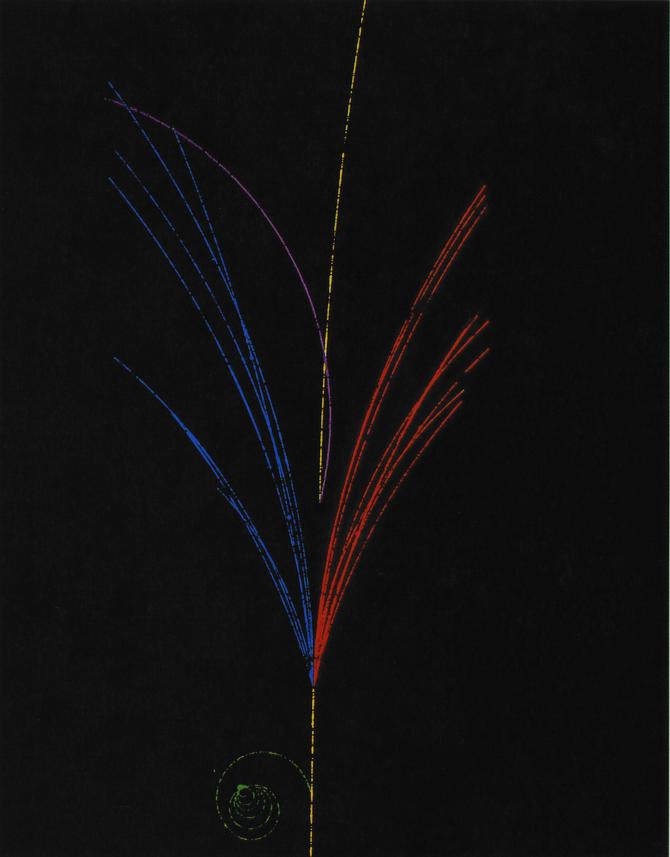
In 1947 George Rochester and Clifford Butler saw something odd in their cloud chamber at Manchester: two tracks springing from a single point, as if from nowhere. They were the decay products of a neutral particle about 1,000 times heavier than the electron: the kaon, the first "strange" particle, so called because these particles live extraordinarily long. By 1951 a heavier strange particle, the lambda, had been found. It was the first hyperon (from the Greek for "over"), with a mass about 20% above the proton's.
Particle proliferation
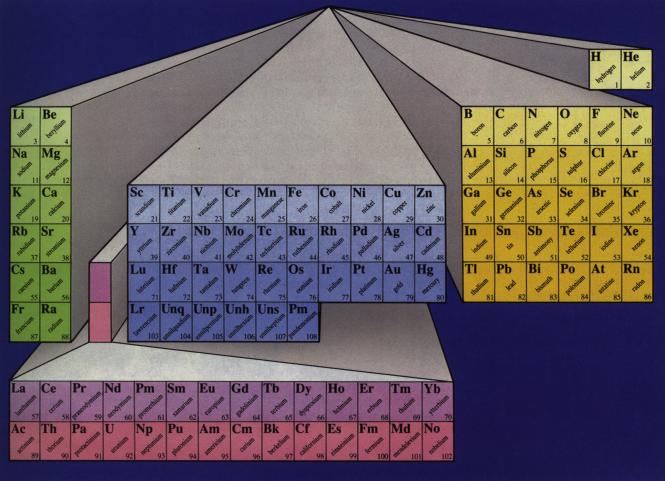
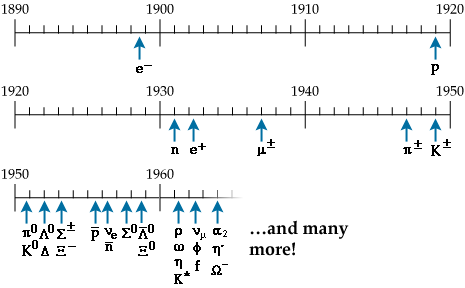
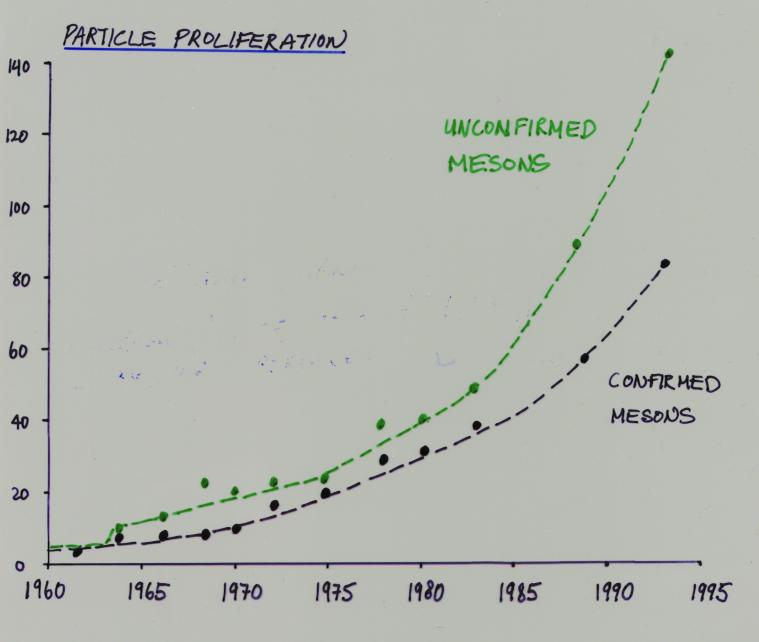
And many more particles were found. How many are there? Why so many? Can they be put in order, as Mendeleev did with the elements?
5Enter quarks
The Eightfold Way
The first step towards order came in 1961 from Murray Gell-Mann and Yuval Ne'eman. They saw that many of the known particles fall into families described by a symmetry group called SU(3). Gell-Mann called the scheme the Eightfold Way, after the Buddha's eightfold path to enlightenment.
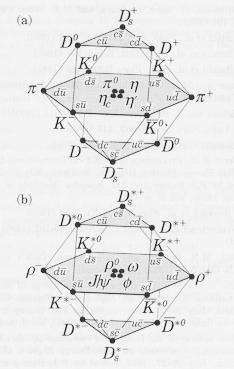
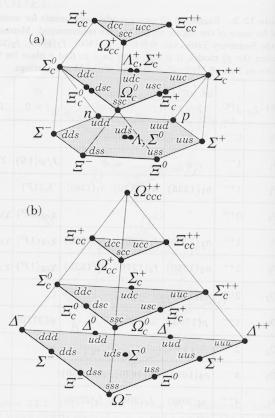
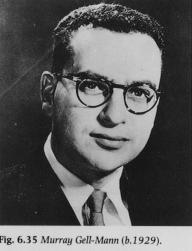
The lowest plane in the baryon figure has a famous story. At a conference at CERN in 1962 the discovery of the cascade (the Greek letter xi) was announced. Gell-Mann and Ne'eman were both in the audience, and both saw that the plane was filling up as their theory predicted, with only its last member missing. Both raised their hands; Gell-Mann was called on. He went to the front and announced that a new particle must exist, the omega-minus, and said what its properties would be. It was found at Brookhaven in 1964, a dramatic confirmation of the Eightfold Way.
Quarks
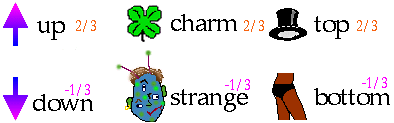
What lies behind the symmetry? In 1964 Gell-Mann and George Zweig independently proposed a new kind of particle with a fraction of the electron's charge. Gell-Mann called them quarks; Zweig called them aces. All the particles then known could be built from three types, up, down and strange. (Perhaps these prosaic names show a decline in classical education, or perhaps physicists were running out of Greek letters.) The lighter particles, now called mesons, are a quark and an antiquark; the heavier ones, now called baryons, are three quarks.
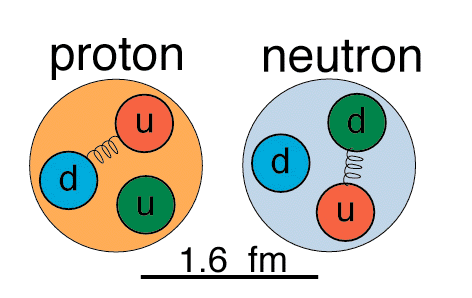
A proton is two up quarks, each of charge +2/3, and a down quark, of charge −1/3; a neutron is two downs and an up; a positive kaon is an up quark and an anti-strange quark (antiparticles have the opposite charge).
+1 = ⅔ + ⅔ − ⅓
0 = ⅔ − ⅓ − ⅓
+1 = ⅔ + ⅓
Three more quarks were found later, making six in three pairs: up and down, charm and strange, top and bottom. Each has an antiquark.
Where the word comes from
quark, n. (Physics): one of several (originally three) hypothetical components of elementary particles. Oxford English Dictionary
"Three quarks for Muster Mark!" James Joyce, Finnegans Wake
Quark, m.: curd, curds; (figuratively) trifle, nothing, rubbish. Cassell's German–English Dictionary
6Colour and confinement
Besides electric charge, quarks carry a second kind of charge, called colour. It has nothing to do with ordinary colour; the name is just a convenient label. There are three colour charges, called red, green and blue, and three anticolours carried by antiquarks. The force between colour charges is the strong force. It binds quarks into protons and neutrons, and, as a side effect, binds protons and neutrons into nuclei. The theory of it is quantum chromodynamics, QCD.
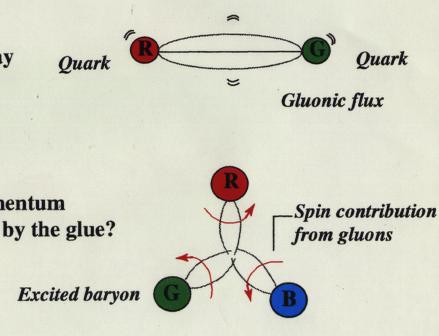
Electric charges attract and repel by exchanging photons; colour charges exchange gluons. The crucial difference is that gluons carry colour themselves, a colour and an anticolour, while photons are electrically neutral. When a quark emits or absorbs a gluon its colour changes, and colour as a whole is conserved: a red quark can turn blue by emitting a red–antiblue gluon. Of the nine colour–anticolour combinations, symmetry removes one, so there are eight gluons.
Confinement
Quarks are never seen alone. They come only in combinations with no net colour: three quarks, one of each colour, or a quark and an antiquark of matching colour and anticolour. This is why the baryons and mesons are the particles we see.
Because gluons carry colour, they attract one another, and the field between two quarks is squeezed into a narrow tube. Pull the quarks apart and the energy in the tube grows with the distance, without limit. Long before a quark gets free, it becomes cheaper for the tube to snap, its energy turning into a new quark and antiquark at the broken ends. Instead of a free quark you get two hadrons.
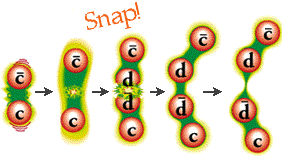
QCD is studied by the particle theory group at Pitt, among many others.
7Heavier quarks
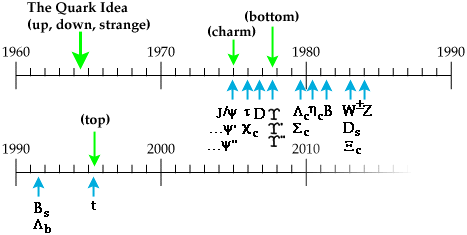
Sometimes a new particle means a new quark. In the "November Revolution" of 1974 the J/ψ was found at the same time by Samuel Ting's group at Brookhaven and Burton Richter's at the Stanford Linear Accelerator Center. It could only be a bound state of a new quark, charm, and its antiquark. The bottom quark followed in 1977, with Leon Lederman's discovery of the upsilon at Fermilab, and the top quark in 1995, also at Fermilab, at a mass of about 173 times the proton's. Measurements of the Z boson at CERN and SLAC show that there are exactly three generations of light neutrinos, and so, very probably, no more quarks of this kind.
8Accelerators and detectors
Accelerating particles
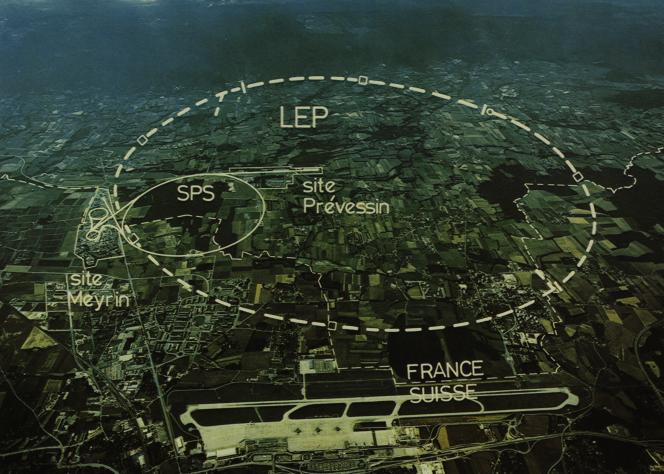
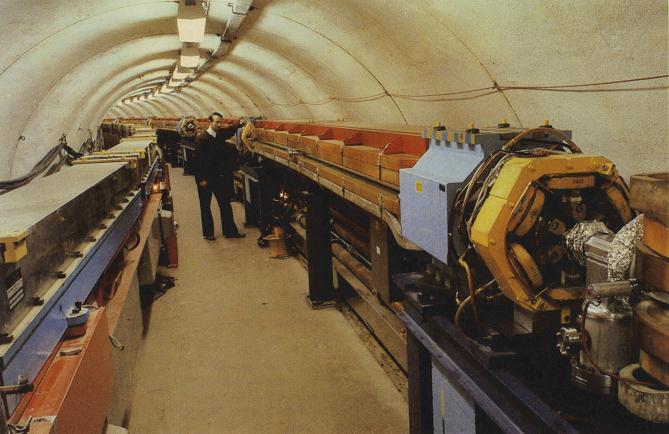
Cosmic rays are enormously energetic but far too unreliable for most experiments, so physicists build their own cosmic-ray machines: accelerators ("atom smashers" in the press). The idea is to get a particle moving very fast and smash it into another. Sometimes new particles are made, sometimes not, but there is always something to learn about how particles interact.
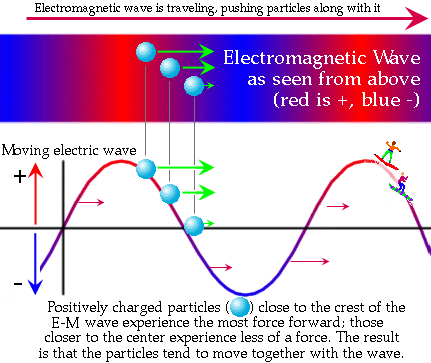
Getting the particles is easy: electrons boil off a hot metal, and protons are hydrogen atoms with the electron stripped off. Accelerating them takes strong electric fields. In a linear accelerator the field is a travelling electromagnetic wave. Particles at the back of a bunch get the biggest push and those at the front the least, so the bunch rides the front of the wave like surfers.
Detecting particles
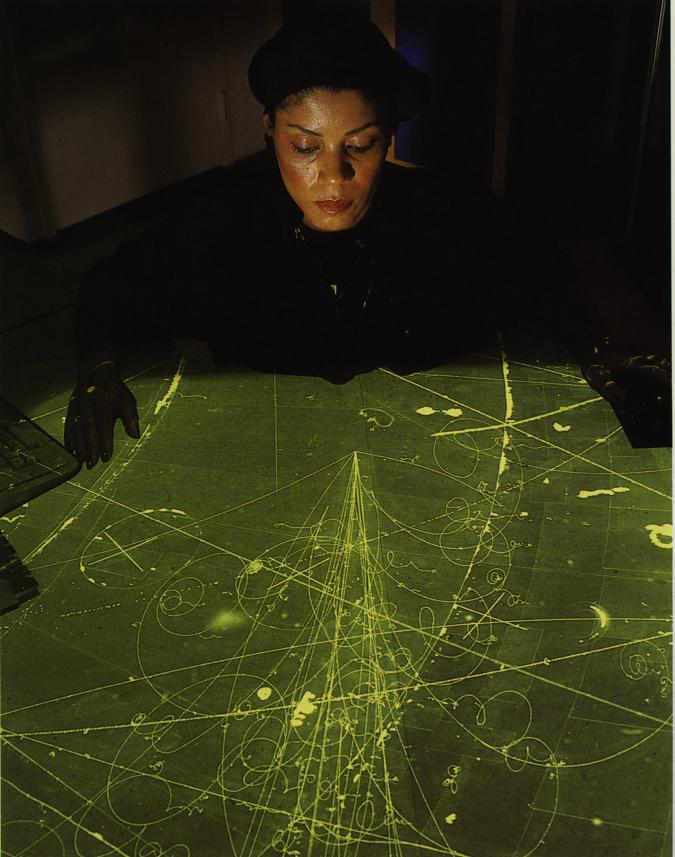
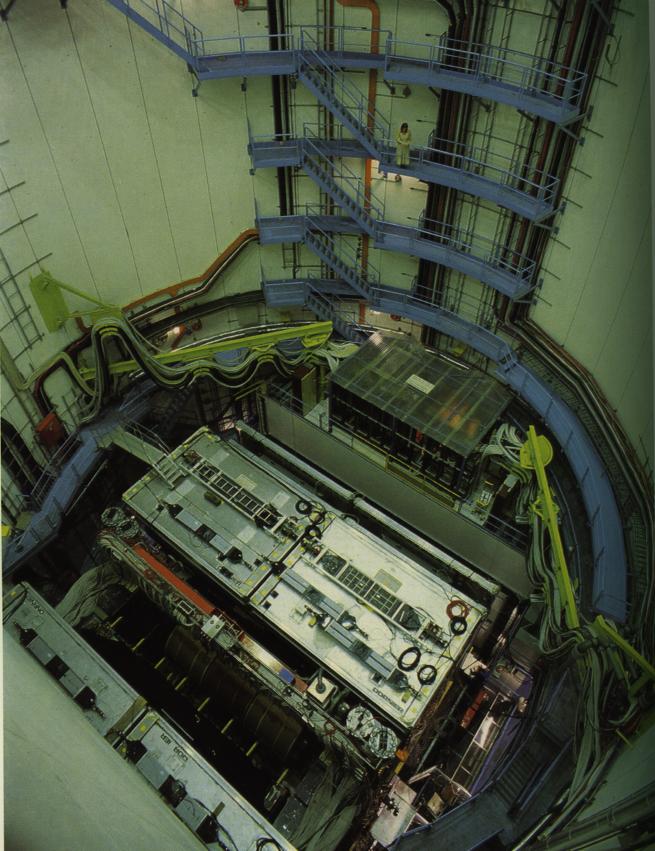
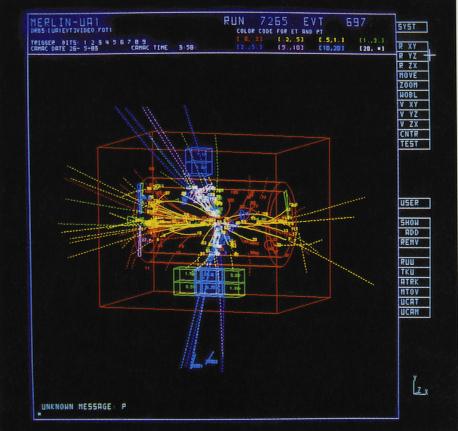
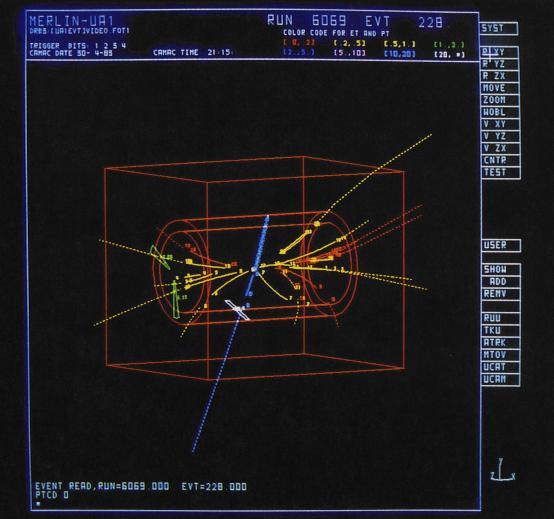
Smashing particles is not enough: we must see what happened. Cloud chambers, bubble chambers and photographic emulsions did this for decades; with computers the same ideas reach far higher sensitivity. Modern detectors are as big as houses, or cathedrals, and cost tens to hundreds of millions of dollars.
Analysing data
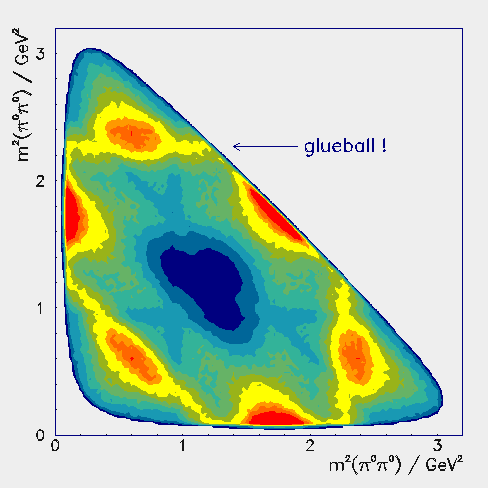
Making sense of the flood of data is an art in itself. One tool is the Dalitz plot, introduced by Richard Dalitz: for a particle decaying to three others, it plots the energies shared between pairs, and patterns in it reveal short-lived intermediate particles.
9Jefferson Lab
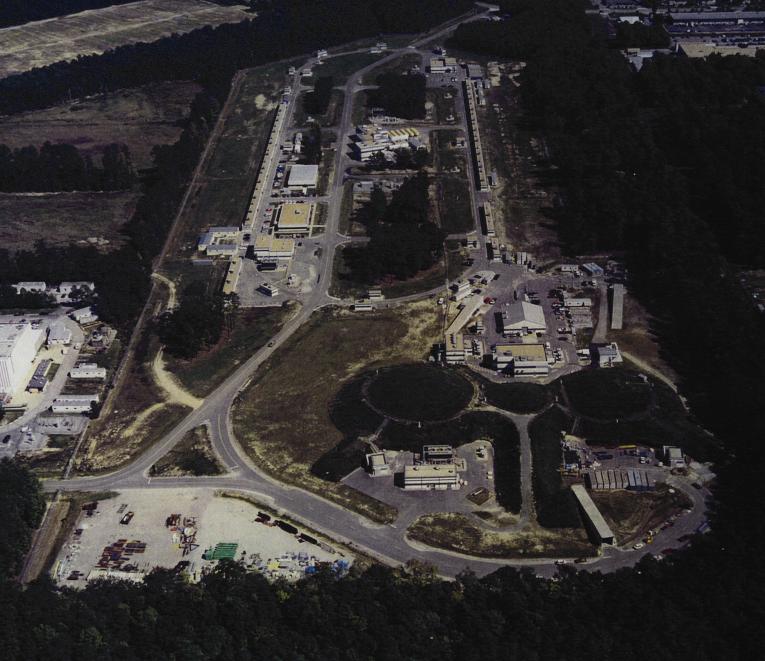
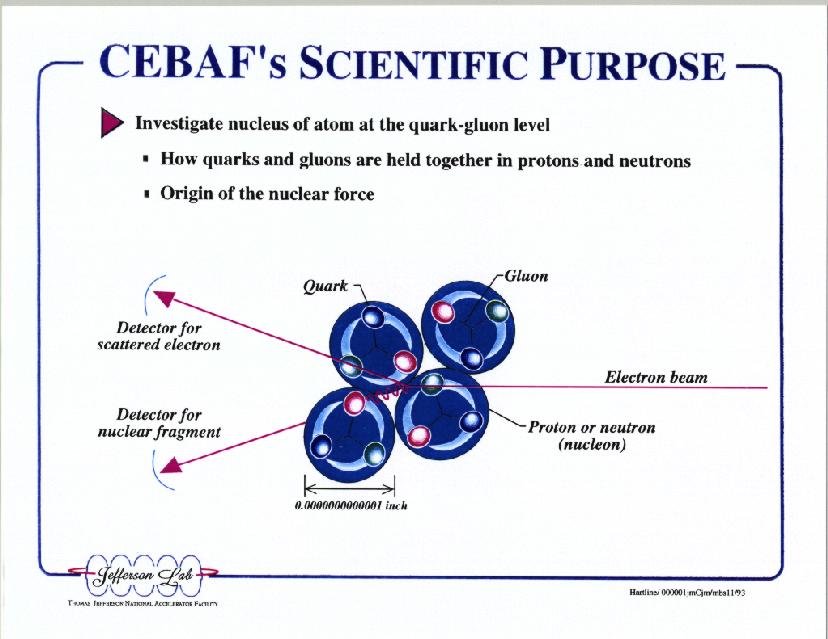
The Thomas Jefferson National Accelerator Facility (Jefferson Lab) in Newport News, Virginia, was built to study how quarks and gluons make up protons, neutrons and nuclei. Its electron accelerator, CEBAF, began experiments in 1995.
The accelerator
Electrons start at the injector and race round an underground, racetrack-shaped tunnel at nearly the speed of light, gaining energy on each lap from superconducting radio-frequency cavities. These are kept at 2 degrees above absolute zero (−456 °F) by liquid helium from the Central Helium Liquefier. In the original machine the beam went round the 7/8-mile tunnel five times in about 25 millionths of a second; at that speed it could circle the Earth seven and a half times in a second. More than 2,200 magnets steer it, and computers in the control room watch over 100,000 signals at once.
The beam is continuous rather than pulsed, so collisions arrive steadily but one at a time, each clean enough to study in full. It can be split among the experimental halls, where it strikes targets such as hydrogen, carbon, gold or lead; measuring the speed, direction and energy of what scatters out shows how the nucleus is put together.
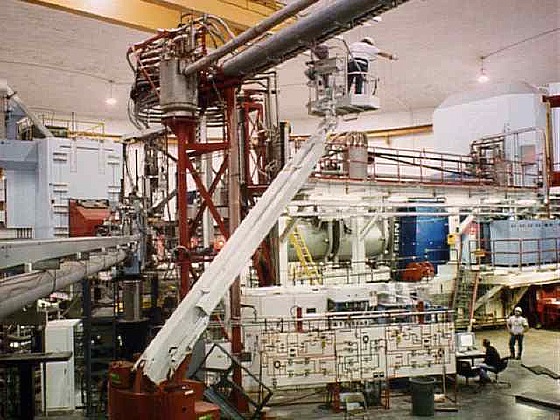
In 2017 an upgrade doubled the energy to 12 GeV and added a fourth hall, Hall D, home of the GlueX experiment. GlueX searches for hybrid mesons, in which the gluon field itself is excited, a direct window on the gluons that hold hadrons together.
10The Standard Model
The size of it all
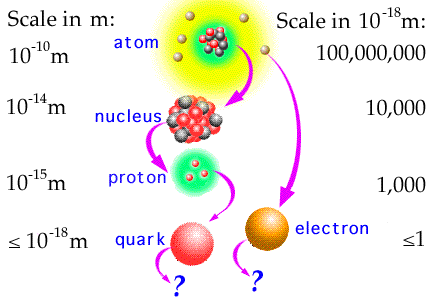
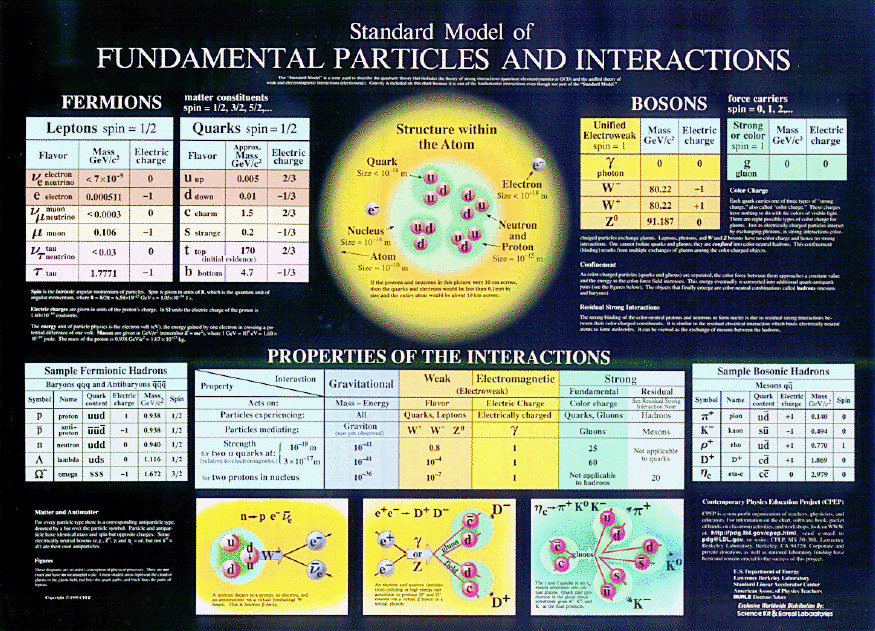
The whole story has been a journey into ever smaller things: the atom at 10⁻¹⁰ m, the nucleus at 10⁻¹⁴ m, the proton at 10⁻¹⁵ m, and the quark, in which no structure has been seen down to 10⁻¹⁸ m.
Nucleons, and the nucleus of lithium-7
A nucleon is a proton or a neutron. They have almost the same mass and behave alike except for their charge: +1 for the proton, 0 for the neutron. In the quark model the only difference is that an up quark in the proton becomes a down quark in the neutron. A nucleon is about 1.6 fm across (1 fm = 10⁻¹⁵ m). The nuclear force has a very short range, so nucleons in a nucleus are packed almost touching.
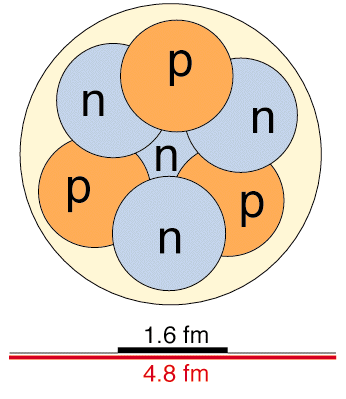
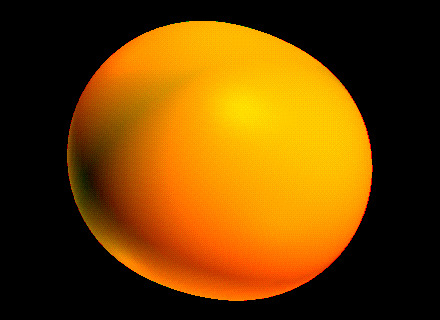
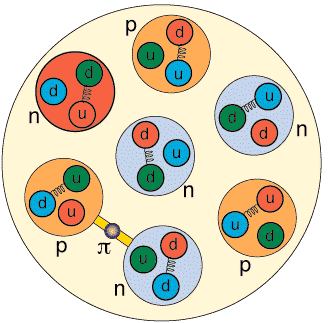
Lithium has three protons. Natural lithium is 92.5% lithium-7, with four neutrons, and 7.5% lithium-6, with three. The two behave almost identically in chemistry, which sees only the nuclear charge, but the nuclei are very different: lithium-7 is not round but stretched like an American football. Its surface is not sharp either; the shape shows where its nucleons are found more than 90% of the time. Look closer still, and each nucleon is three quarks bound by gluons.
The particles of the Standard Model
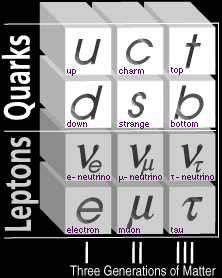
Everything we know of is made of six quarks and six leptons (the electron, the muon, the tau and their three neutrinos), in three generations. The forces are carried by more particles: the photon for electromagnetism, gluons for the strong force, and the W and Z bosons for the weak force. The Higgs boson, found in 2012, completes the set. Gravity is the odd one out: its carrier, the graviton, is expected but has not been seen.
11Particles at work
It would be a mistake to think all this effort is a waste of time and money. There is a famous story about Queen Victoria visiting J. J. Thomson's laboratory after he discovered the electron. "Of what use are these electrons?" she asked. I have heard two versions of his reply. "I do not know, but rest assured that one day you will tax it" seems a little cheeky, even for a professor, so I prefer the other: "Madam, of what use is a newborn baby?"
Physicists fall for Queen Victoria's attitude too. I was once astonished to meet someone using pion beams as a practical tool for cancer therapy: the very particles I had spent years trying to understand in theory.

12Since then
This tour was first written in the 1990s. Much has happened since.
- Neutrinos have mass. Experiments in Japan (Super-Kamiokande, 1998) and Canada (SNO, 2001) found neutrinos changing type as they travel, which is possible only if they have mass, a crack in the original Standard Model.
- The Large Hadron Collider. The LHC, in LEP's old tunnel at CERN, began colliding protons in 2010, at energies now up to 6.8 TeV per beam.
- The Higgs boson. On 4 July 2012 the ATLAS and CMS experiments at the LHC announced the Higgs boson, the last missing piece of the Standard Model. François Englert and Peter Higgs shared the 2013 Nobel Prize.
- Exotic hadrons. For forty years every hadron fitted the quark model's mesons and baryons. Then in 2003 the Belle experiment found the X(3872), a charm–anticharm particle that did not fit. Dozens more followed: charged charmonium-like states such as the Zc(3900) (BESIII and Belle, 2013), which must contain at least four quarks; pentaquarks at the LHCb experiment (2015); and a particle that decays to two J/ψ, the X(6900) (LHCb, 2020), perhaps made of four charm quarks. Whether these are tightly bound multiquark states, loosely bound "molecules" of ordinary hadrons, or effects of the thresholds where new decays open up, is one of the liveliest questions in the field, and the subject of much of my own research.
- Gluons in the spotlight. Jefferson Lab's 12 GeV upgrade and GlueX search for hybrid mesons, and a new Electron–Ion Collider at Brookhaven will map how quarks and gluons share the proton's mass and spin.
Timeline
| Year | Event |
|---|---|
| 1896 | Becquerel discovers radioactivity |
| 1897 | Thomson discovers the electron |
| 1900 | Planck: radiation is emitted in quanta |
| 1905 | Einstein: light quanta (photons); special relativity |
| 1911 | Rutherford infers the nucleus from Geiger and Marsden's scattering |
| 1912 | Hess: cosmic rays come from space |
| 1913 | Bohr's quantum model of the atom |
| 1919 | Rutherford finds the proton |
| 1923 | Compton scattering confirms the photon |
| 1925–26 | Quantum mechanics: Heisenberg, Schrödinger, Born; Pauli's exclusion principle |
| 1928 | Dirac's relativistic equation predicts antimatter |
| 1930 | Pauli proposes the neutrino |
| 1932 | Chadwick discovers the neutron; Anderson the positron |
| 1935 | Yukawa predicts a meson as carrier of the nuclear force |
| 1936 | The muon ("Who ordered that?") |
| 1947 | The pion; the first strange particles |
| 1956 | Cowan and Reines detect the neutrino |
| 1961 | The Eightfold Way (Gell-Mann, Ne'eman) |
| 1964 | Quarks proposed (Gell-Mann, Zweig); the omega-minus found; the Higgs mechanism |
| 1965 | Colour charge (Greenberg; Han and Nambu) |
| 1967–68 | Electroweak theory (Glashow, Weinberg, Salam) |
| 1968–69 | Deep inelastic scattering at SLAC sees point-like constituents in the proton |
| 1973 | Asymptotic freedom (Gross, Wilczek, Politzer): QCD; weak neutral currents seen at CERN |
| 1974 | The J/ψ: charm |
| 1975 | The tau lepton |
| 1977 | The upsilon: bottom |
| 1979 | Gluon jets at DESY |
| 1983 | The W and Z bosons at CERN |
| 1989 | LEP and SLC: three generations of light neutrinos |
| 1995 | The top quark at Fermilab |
| 1998 | Neutrino oscillations: neutrinos have mass |
| 2003 | The X(3872), the first of the exotic charmonium-like states |
| 2012 | The Higgs boson at the LHC |
| 2015 | Pentaquarks at LHCb |
Further reading
- The discovery of the pion, 1947, from the CERN Courier (1997).
- The Particle Adventure, an interactive tour of the Standard Model from the Particle Data Group.
- The Particle Data Group, which publishes the Review of Particle Physics.