Research · gluonic matter
Hybrids That Shine: Radiative Transitions of Charmonium Hybrids
A hybrid meson can shed its gluonic excitation by emitting a photon. How often it does so tells us how the excited gluon is put together.
1Hybrid mesons
An ordinary meson is a quark bound to an antiquark. A hybrid meson has, in addition, an excited gluon: the field that binds the quarks is itself vibrating. Hybrids are a direct window on how gluons behave when they carry energy and angular momentum, and finding them is a central goal of the GlueX experiment at Jefferson Lab.
Heavy quarks make the problem cleaner. In charmonium hybrids, a charm quark and antiquark (\(c\bar c\)) sit in their lowest state while the gluon carries the excitation. Lattice QCD finds the lowest of these hybrids as a family of four states with quantum numbers \(J^{PC} = 1^{--}, 0^{-+}, 1^{-+}, 2^{-+}\). The \(1^{-+}\) member, called \(\eta_{c1}\), is exotic: no quark–antiquark pair can have these quantum numbers, so seeing it would be a clear sign of gluonic excitation. The \(1^{--}\) member is called \(Y\).
2What is a radiative transition?
A radiative transition is a decay in which a hadron emits a photon and drops to a lighter state, much as an excited atom emits light. For a hybrid the interesting case is
for example \(Y \to \eta_c\gamma\) or \(\eta_{c1} \to J/\psi\,\gamma\). The final meson has no gluonic excitation, so the gluon has to disappear while the photon is emitted. The rate of such a decay measures how the gluon and the photon talk to each other through the quarks. It also matters for experiment: GlueX uses a photon beam to make hybrids, which is the same process run backwards.
The rates are quoted as decay widths \(\Gamma\) in keV. A larger width means a faster decay.
3How the calculation works
The calculation uses the Coulomb-gauge picture of QCD, in which the gluon behaves like a particle with an effective mass of about 600 MeV (a constituent gluon). The charm quark is heavy, so the interactions can be organised in powers of \(1/m_c\), as in heavy-quark effective theory.
The leading process is a seagull (SG1 in Figure 1): the gluon is absorbed and the photon emitted at the same point on the charm-quark line. This is the largest term, of order \(1/m_c\). It does not flip the quark spin, so it connects hybrids and mesons with the same total quark spin. Three smaller terms, of order \(1/m_c^2\), involve the quark spin and the instantaneous force between the quarks (SG2 to SG4). These are the only route for transitions in which the quark spin changes.

4Results
Because the leading seagull is so simple, the model predicts similar widths for most transitions: roughly 10 to 20 keV each. Only two of these decays have been computed in lattice QCD, and Figure 2 compares them.
- \(Y \to \eta_c\gamma\): the model gives 22 keV, against 42 ± 18 keV from the lattice, and about 30 keV from a newer lattice calculation with dynamical quarks. These agree within the uncertainties.
- \(\eta_{c1} \to J/\psi\,\gamma\): the model gives 14 keV, well below the lattice values of about 105 to 115 keV. Here the spin-dependent terms partly cancel the leading one. The disagreement is not understood and is an open question.
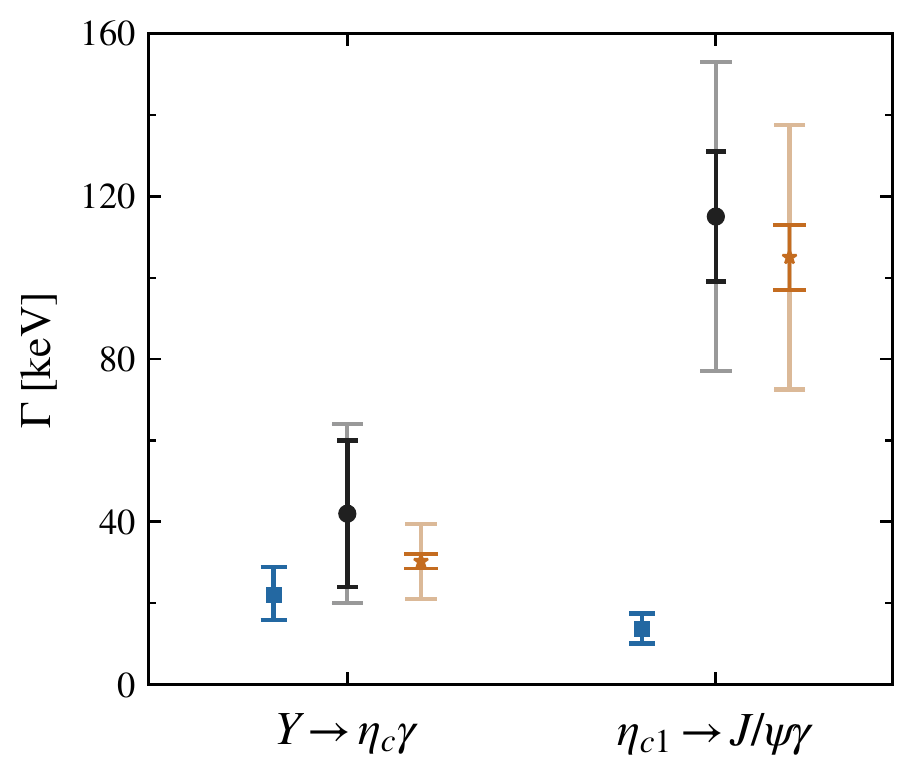
The paper also predicts eight transitions that have not been computed on the lattice (Table 1). Two patterns stand out: the \(2^{-+}\) hybrid should decay to \(J/\psi\,\gamma\) about four times as often as to \(h_c\gamma\), and the three decays \(Y\to\chi_{cJ}\gamma\) should have similar rates.
| Transition | Q (GeV) | Model Γ (keV) | Lattice Γ (keV) |
|---|---|---|---|
| \(Y \to \eta_c\gamma\) | 1.188 | 22 | 42(18) |
| \(Y \to \chi_{c0}\gamma\) | 0.875 | 10 | ≲ 20 |
| \(Y \to \chi_{c1}\gamma\) | 0.799 | 10 | — |
| \(Y \to \chi_{c2}\gamma\) | 0.763 | 15 | — |
| \(H_1(0^{-+}) \to J/\psi\,\gamma\) | 1.019 | 6 | — |
| \(H_1(0^{-+}) \to h_c\gamma\) | 0.688 | 36 | — |
| \(\eta_{c1} \to J/\psi\,\gamma\) | 1.035 | 14 | 115(16) |
| \(\eta_{c1} \to h_c\gamma\) | 0.705 | 7 | — |
| \(H_1(2^{-+}) \to J/\psi\,\gamma\) | 1.152 | 41 | — |
| \(H_1(2^{-+}) \to h_c\gamma\) | 0.834 | 9 | — |
Changing the sizes of the hybrid and meson wave functions by 10% changes the predicted widths by 10 to 20%. The lattice values in Table 1 are quenched results with statistical errors only.
5What comes next
More lattice calculations of these transitions, in particular of the eight new predictions, would test the constituent-gluon picture directly. The natural extension is to light-quark hybrids, whose radiative transitions are what the GlueX experiment can produce.
6Paper and references
S. Jafarzade and E. S. Swanson, "Radiative transitions of hybrid mesons", arXiv:2610.22088 [hep-ph] (2026).
- J. J. Dudek, R. G. Edwards and C. E. Thomas, "Exotic and excited-state radiative transitions in charmonium from lattice QCD", Phys. Rev. D 79, 094504 (2009), arXiv:0902.2241.
- J. Delaney, C. E. Thomas and S. M. Ryan (Hadron Spectrum), "Radiative transitions in charmonium from lattice QCD", JHEP 2024 (05), 230, arXiv:2301.08213; J. Delaney, PhD thesis, University of Cambridge (2023).
- A. P. Szczepaniak and E. S. Swanson, "Coulomb gauge QCD, confinement, and the constituent representation", Phys. Rev. D 65, 025012 (2001), hep-ph/0107078.