This is a simulation that we did not have time for in the first
class. It illustrates conservation of energy for a case where
kinetic energy and potential energy are the only kinds of energy that
play a role.
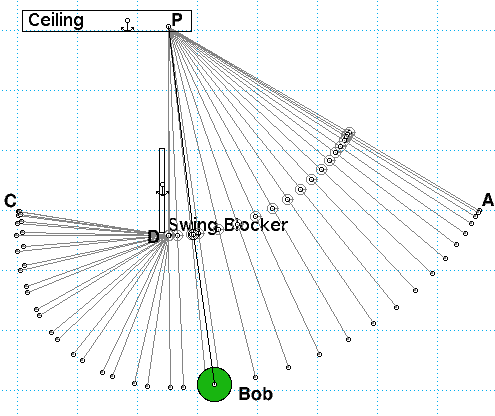
The green pendulum bob is suspended from point P on the ceiling.
It is drawn aside to point A, held at rest, and then released. It
swings down until an obstacle (labelled "Swing Blocker") at D prevents
the upper part of the string from moving any further. In
effect, this converts the pendulum, which was of length PA, into a
pendulum of shorter length DC. The bob continues to point C, and
then begins its return journey to point A. The bob is shown just
after it has reached the lowest point of its return swing. The
Ceiling and the Swing Blocker are both kept stationary, as indicated by
the small anchor on each of them. The string PA (or PDC) has a
negligible mass, so its kinetic energy can be taken as zero.
At A, total energy = PE + KE = mghA +
0 (KE = 0 because the bob is initially at rest.)
At C, total energy = PE + KE = mghC +
0 (KE = 0 because the bob is at rest for an instant when it
reaches the top of its motion at C.)
By energy conservation, the bob must have the same total energy at C as
it had at A.
Therefore mghC + 0 = mghA
+ 0
Consequently hC = hA
The bob rises to the same
height at C as it initially had at A.
This happens even though points A and C are not
symmetrically related, so it is not an obvious result. The
analysis depends on the rather
subtle fact that the force exerted on the bob by the string does
no work, and makes no contribution to the potential energy.