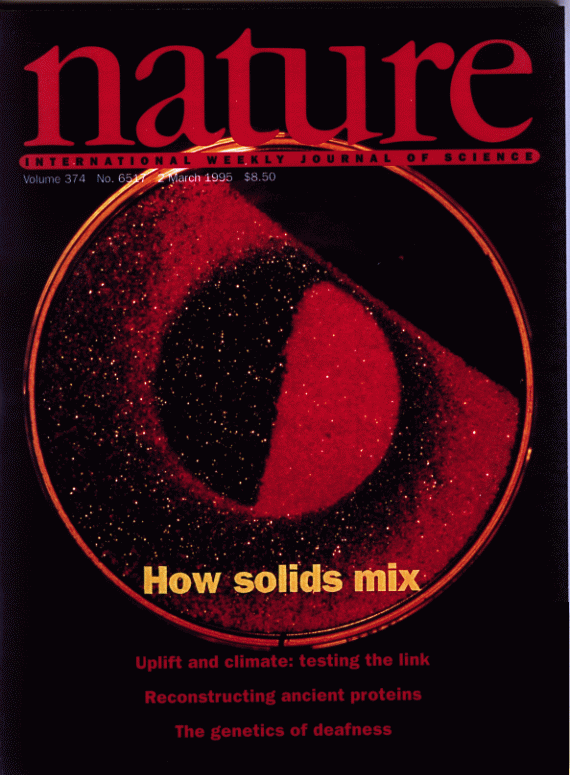
AVALANCHE MIXING OF GRANULAR SOLIDS
-
Guy Metcalfe, Troy Shinbrot, J.J. McCarthy, & Julio M. Ottino
As an example of a system to be modelled, consider an upright 2-dimensional
disk partially filled with colored passive particles and rotating about its axis
(Fig. 1). For slow rotation, the surface layer mixes through the action of successive
avalanches. Slow mixing requires that each avalanche completely stop before a new one
begins. The avalanche duration scales as sqrt(D/g), where D is the container diameter and
g is gravity. We require sqrt(D/g) << 1, where W is the rotation rate. Material below
the surface layer rotates as a solid body with the disk.
Experimentally, the disk is thin enough for the dynamics to occur in a plane.
While individual grains in the experiment may take a 3-dimensional path during
an avalanche, we observe through the front and back of the glass disk that the macroscopic
structures---boundaries,
streaks, and core---extend entirely through the material layer. Large-scale
structures remain planar and the experimental flow may be assumed to be 2-dimensional.
The particles used are dyed table salt -- cubes with a mean side length of 0.6 mm --
and the disk is 240 grains in diameter and 40 grains deep. An avalanche occurs when
the surface slope exceeds Theta-i ~ 60, after which the surface returns to its angle of
repose, Theta-f ~ 52, as sketched in Fig. 1. For salt we measure
(Theta-i) - (Theta-f) = (8 +/- 2).
The detailed mechanism for avalanches is not entirely understood and has been the topic of
considerable research [1-6, 23, 24]. However, these details are not important here.
The crucial point is that the surface motion that causes mixing is iterative; that is, one
avalanche looks much like another, and the process of mixing can be represented as
successive, nearly identical, avalanches which are repeated over and over.
The idea of the model is as follows. Consider any closed and slowly rotating
mixing vessel, partially filled with granular material. Industrial examples of this
kind of mixer include the V-blender, the tube or drum mixer, and the rotating kiln.
The crucial observation is that irrespective of the detailed dynamics of the avalanche
itself, the result of the avalanche is to transport an initial wedge of material
(Fig. 1) downhill to a new wedge. Thus we can divide the
problem of avalanche mixing into two distinct parts: transport of wedges and transport
within wedges. The transport of wedges is geometrical and the transport within wedges
can be represented mathematically by a map. As we will show, even without knowing the
details of the dynamics within the wedges, it is possible to predict the mixing
behavior to a surprising degree of accuracy.
Consider now the special case of the disk of Fig. 1. Transport between wedges
occurs only in areas where successive wedges intersect. These intersections take the
shape of quadrilaterals whose size varies with fill level, f, defined to be the
fraction of the diameter occupied by the grains. For uniformly convex containers,
analysis immediately reveals the following. (1) For f < 1/2, the quadrilateral
intersections widen as the fill level decreases, so mixing should be faster for lower
fill levels. (2) At f = 1/2, the quadrilaterals collapse, and mixing between wedges
should vanish. (3) For f > 1/2 + e (e being the thickness of a boundary layer), the
wedges cannot penetrate into the center of the disk, and a non-mixing core should
appear. (4) The fractional area of the core should grow as (2f-1-(e/R)^2), where R is
the radius of the disk. (5) Also for f > 1/2 + e, new quadrilaterals emerge, and
mixing outside of the core should resume; mixing should be impeded, however, because
material must be transported around the core. (6) As the core grows, the distance
around the core also grows, and transport (mixing) should again slow. Each prediction
is testable and is verified by experiment. In Fig. 2, we show side-by-side
comparisons between an experiment and a numerical simulation, using a random map to
model mixing within the wedges. Other maps can be devised to more realistically
probe the mixing dynamics -- for example by molecular dynamics [26], continuum
mechanics [27], or cellular automata [1] techniques.
In our investigations with monodisperse granular solids, we find that the simple
random map gives surprisingly good agreement.
As an example of a quantitative comparison, we track the position of the
centroid of the two groups of differently colored particles and normalize the two
color centroid locations to that of the entire material's center of mass. Figure 3a
shows typical data as a function of time for one centroid's orbit. Disk rotation
causes the centroid orbits to oscillate, whereas the iterative avalanches cause the
orbits to decay exponentially. The decay time-constant g, shown in Fig. 3b as a
function of f, defines a mixing rate. The mixing rates calculated by simulation, which
uses only random mixing, are consistently higher than the measured rates for f < 1/2.
Nonetheless, the experiments and simulations well confirm the geometric predictions.
We can also determine a measure of mixing efficiency and optimum operating point. The
volume of material mixed is V(f), where V is the volume of the disk occupied by the
powder, and we take V(f=1) = 1. Optimal mixing occurs when X = gV(f), the volume of
powder mixed per characteristic time, is maximized. The inset to Fig. 3b shows the efficiency with
the experimental (calculated) optimum occurring at f = 0.23 (0.25). The error bars
displayed are due to uncertainties in the exponential fit.
The model which we have presented is undoubtedly simple. For the future,
several extensions are indicated, some of which have been studied in our laboratory.
First, we have discussed only a quasi-2D, slowly rotating mixer. Second, we have only
presented mixing within uniformly convex containers. Third, we have neglected
interactions between particles -- e.g. cohesion, triboelectrification, arching, etc.
-- which are known to influence particulate flow and fourth, we have only considered
monodisperse particles.
Extension to three dimensions is not difficult. In three dimensions, slow mixing still occurs via avalanches which effectively transport material downhill from one wedge to another. Wedge shapes vary in a complex way, and wedge maps may be complicated; nevertheless, the same idea holds. We have investigated mixing in more complex geometries as well; for example Fig. 4 shows an experimental-computational comparison of mixing within a thin square container. We have also found that concavities in the container shape (as occur, for example, in a baffled container) can in some circumstances eliminate the core. This occurs because the angle of repose keeps gravity from filling the concavity initially until rotation sufficiently increases the material slope in the cavity. When this expanding avalanche within the cavity occurs underneath the core, the core location can shift into the mixing zone. mitigate the interference of mixing due to the core. This occurs because grains tend to only partially fill these concavities at first. The bulk of the material settles as the concavity later fills, and as a result, the core is moved away from its original position and thereafter participates in mixing. This complication can be included in a straightforward way. Interactions represent the most serious challenge for our model. Nevertheless, experiments with weakly cohesive particles reveal that geometrical structures persist. We are hopeful that approaches of this kind, modeling only the most basic mechanisms and including complications as needs arise, may lead to successful analyses of complex granular flows.