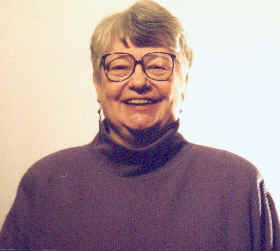
|
NAME: Noreen B. Garman, Ph.D.
TITLE: Professor of Education
Coordinator, Social and Comparative
Analysis in Education Program
AFFILIATION; Department of Administrative and Policy
Studies
University of Pittsburgh
BIOSKETCH
I began my teaching career as a high school English
teacher who also directed the dramatic activities.. I really can’t
remember a time when I wasn’t teaching. “Doing teaching” has been my
occupation: “understanding teaching” has been my preoccupation. In 1968 I
began to supervise teaching both in the public schools and the University.
My dissertation research focused on an instructional supervision program
for teaching assistants in the English Department at the University of
Pittsburgh. Since then I have been teaching courses in instructional
supervision, curriculum studies and adult learning. I also teach
qualitative research and ways of knowing.
I like to think that I bring an interpretivist
orientation from my roots in the arts to my research and practice in
education. The longer I have studied teaching, however, the more
confounding, even mysterious, the educative act is for me. Two decades ago
I was more certain. At that time I was influenced by the
behavioral/mechanistic language of curriculum and teaching, yet always
feeling at odds with the neutral functionalism and certitude that
dominated our field. I know now that I was experiencing what our study
group has called “ontological dissonance” and for a few early years I had
no way to name my ideas. Eventually I began writing about supervision and
curriculum from an interpretivist stance and at some point realized that I
had found a linguistic home in the world view I could now claim.
How fortunate I have been these last 35 years to have
been engaged in exciting activites, or, put another way, to be paid to do
what I love, to teach and write. In addition, because of my writings I’ve
managed to work extensively in Australia, to lecture in Korea and to take
a senior Fulbright position in the Philippines. In the mid 1990’s I
directed two educational programs in Bosnia during and after the war. As a
result of my international focus I’ve taken on administrative duties and,
as so often happens, find myself often consumed by expedient
organizational demands even though much about administrative work is
grounded in what I continue to think of as the mysteries of the educative.
One of many beliefs about teaching continues to crowd
my inquiry. It is the belief that teaching is a moral craft. As teachers
we are continually confronted with moral dilemmas. If it is possible to
define good teaching I would posit that it resides in the struggle to come
to terms with our dilemmas. We struggle to balance a sense of duty to our
students on one hand and the integrity of our discipline on the other. We
recognize that there is an intentionality about teaching which cannot
guarantee learning., so we are obliged to be vigilant during the time we
have with our students. We try to balance the high intellectual standards
of the university on one hand with the self-esteem of the learners on the
other. We recognize the high degree of manipulation in what we call
teaching. We confront the ideologies which conflict with our own. We
wonder how much we do to enhance our own egos. We are passionate about
ideas and try to infuse intellectual rigor with a sense of compassion. We
are too often overextended and tired. We get annoyed with superficial
thinking and self-promoting behavior. Still we recognize the importance of
mutual respect. For me, the moral struggle is central to the craft of
teaching and I am still enchanted with the possibilities for inquiry
within the struggle.
Over the years the study group has been the center of
intellectual nourishment which has helped me to name my deepest insights.
The study group is truly a community of learners.
Selected Publications
Piantanida, M. and Garman, N. (1999) The
Qualitative Dissertation: A Guide for
Faculty and Students. Thousand
Oaks, CA: Corwin Press.
Piantanida, M., Garman, N.& McMahon. (2000) Crafting an arts-based
educational research thesis: Issues of tradition and solipsism. In
P.Willis , et.al. (eds.) Being, Seeking, Telling :Expressive Approaches
to Qualitative Adult Education Research. Flaxton, Australia: Post
Pressed.
Piantanida, M., McMahon, P,. & Garman,. (April, 2003). Shaping the
conversational contours of arts-based research in education.
Qualitative Inquiry. 9/2
Garman,
N. & Holland, P. (1995).The rhetoric of school reform reports: Sacred,
skeptical and cynical interpretations. In R. Ginsburg& D. Plank,
Commissioners, Reports Reforms and Educational Policy. Praeger
Publishers.
Neville, R. and Garman, N. (1998). “Philosophic Approaches to School
Supervision.” In J. Firth and E. Pajak (eds), The Handbook on Research
in School Supervision. Macmillan Library Reference USA.
Garman,
N. (1998). “Journey from Exotic Horror to Bitter Wisdom: Research and
Development in Bosnia & Herzegovina.” In J. Smyth and G. Schacklock (eds.)
Being Reflexive in Critical, Social and Educational Research. NY:
Falmer Press.
Garman,
N. (1996) “Qualitative Inquiry: Meaning and Menace for Educational
Researchers.” In P. Willis and B. Neville (eds.), Qualitative Research
Practice in Adult Education. Ringwood, Victoria, Australia. David
Lovell Publishing.
Garman,
N. (1995) “Beyond the Reflective Practitioner and Toward Discursive
Practice.” Teaching and Teachers Work, vol.3, no.1. Australia.
Garman,
N. (1990) “Values Education in the Philippines and the Living Curriculum.”
Educational Quarterly, vol.37, no.1.
This page was last updated on
07/23/03. |