Cycling Research
Effects of a Core Strengthening Program on Cycling Mechanics and Pedaling Efficiency
Effects of a Cycling Training Program on Pedaling Efficiency
Overview
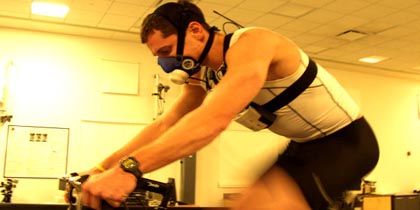
The cycling research project was implemented to integrate scientific data with practical application for the competitive and recreational cyclist. This research agenda will focus on identifying physiological and biomechanical deficits in cyclists while developing methods to improve upon these deficits. Implementation of training programs will be designed based on scientific data to help the cyclist enhance performance. Laboratory testing will be developed to better simulate actual riding by testing subjects while riding on treadmills and under various degrees of fatigue.
Effects of a Core Strengthening Program on Cycling Mechanics and Pedaling Efficiency
 The
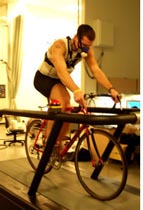
purpose of this study is to evaluate the influence of an 8 week core strengthening
training program designed to improve cycling mechanics and pedaling efficiency
in competitive cyclists. Thirty competitive cyclists will be randomized
to either an intervention (core training) or control group and undergo
8 weeks of training. Testing will consist of riding on a treadmill at
a speed of 16 mph with the incline increasing 1% every three minutes until
exhaustion as indicated by the subject. Outcome measures will include
joint kinematics and pedaling efficiency and will be recorded during the
last thirty seconds of each three minute phase as well as strength testing
of the torso. The cycling mechanics and pedaling efficiency tests and
strength tests will take place at time 0-weeks and 8-weeks. Our overall
hypothesis is that competitive cyclists who perform the core training
protocol will improve their cycling mechanics, be more resistant to core
fatigue, and improve pedaling efficiency as compared to the control group.
The
purpose of this study is to evaluate the influence of an 8 week core strengthening
training program designed to improve cycling mechanics and pedaling efficiency
in competitive cyclists. Thirty competitive cyclists will be randomized
to either an intervention (core training) or control group and undergo
8 weeks of training. Testing will consist of riding on a treadmill at
a speed of 16 mph with the incline increasing 1% every three minutes until
exhaustion as indicated by the subject. Outcome measures will include
joint kinematics and pedaling efficiency and will be recorded during the
last thirty seconds of each three minute phase as well as strength testing
of the torso. The cycling mechanics and pedaling efficiency tests and
strength tests will take place at time 0-weeks and 8-weeks. Our overall
hypothesis is that competitive cyclists who perform the core training
protocol will improve their cycling mechanics, be more resistant to core
fatigue, and improve pedaling efficiency as compared to the control group.
Effects of a Cycling Training Program on Pedaling Efficiency
 The
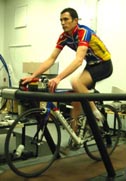
purpose of this study is to evaluate the influence of an 8-week roller
training program designed to improve pedaling efficiency in competitive
cyclists. Thirty competitive cyclists will be randomized to either an
intervention (roller training) or control group and undergo 8 weeks of
training. Testing will consist of riding on a treadmill at a speed of
16 mph with the incline increasing 1% every three minutes until exhaustion
as indicated by the subject. Outcome measures will include joint kinematics
and pedaling efficiency and will be recorded during the last thirty seconds
of each three minute phase throughout the test. The pedaling efficiency
tests will take place at time 0-weeks and 8-weeks. Our overall hypothesis
is that competitive cyclists who perform training on the rollers will
improve their pedaling efficiency as compared to the control group.
The
purpose of this study is to evaluate the influence of an 8-week roller
training program designed to improve pedaling efficiency in competitive
cyclists. Thirty competitive cyclists will be randomized to either an
intervention (roller training) or control group and undergo 8 weeks of
training. Testing will consist of riding on a treadmill at a speed of
16 mph with the incline increasing 1% every three minutes until exhaustion
as indicated by the subject. Outcome measures will include joint kinematics
and pedaling efficiency and will be recorded during the last thirty seconds
of each three minute phase throughout the test. The pedaling efficiency
tests will take place at time 0-weeks and 8-weeks. Our overall hypothesis
is that competitive cyclists who perform training on the rollers will
improve their pedaling efficiency as compared to the control group.
Injury Prevention in Recreational Cyclists
The primary purpose of this study is to compare the physical characteristics of healthy recreational cyclists to those of cyclists who experience knee or back pain. Flexibility of the quadriceps, hamstrings, hips, and low back and pedaling characteristics will be compared between the three groups. The secondary purpose is compare the bike fitting characteristics of healthy recreational cyclists and injured cyclists to the recommended guidelines. Fitting characteristics will include positioning of saddle height, fore/aft saddle position, pedal crank length, handlebar height, handlebar width, and frame size.