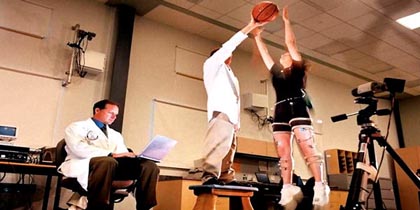
Female ACL Injury Prevention Program
 Over
the last decade the Neuromuscular Research Laboratory has conducted research
examining the risk factors for noncontact ACL injuries in female athletes
and the role of intervention strategies to reduce the risk for injury.
Our research agenda has been modeled after the public health approach
to the injury control process which integrates a five step process designed
to determine injury patterns, risk factors for injury, and the effectiveness
of intervention programs. Our previous research has focused on identifying
modifiable neuromuscular and biomechanical differences between female
and male athletes and the effect of an intervention training program designed
to alter these potential risk factors. Currently we are examining the
hormonal influence on risk factors for injury, comparing genders while
performing a reactive athletic task, and determining the predictive ability
of neuromuscular and biomechanical characteristics on dynamic knee stability.
In the future we will continue to explore the risk factors for noncontact
ACL injury, the role of neuromuscular development in adolescent athletes
on these risk factors, and the influence of training on adaptability and
retention.
Over
the last decade the Neuromuscular Research Laboratory has conducted research
examining the risk factors for noncontact ACL injuries in female athletes
and the role of intervention strategies to reduce the risk for injury.
Our research agenda has been modeled after the public health approach
to the injury control process which integrates a five step process designed
to determine injury patterns, risk factors for injury, and the effectiveness
of intervention programs. Our previous research has focused on identifying
modifiable neuromuscular and biomechanical differences between female
and male athletes and the effect of an intervention training program designed
to alter these potential risk factors. Currently we are examining the
hormonal influence on risk factors for injury, comparing genders while
performing a reactive athletic task, and determining the predictive ability
of neuromuscular and biomechanical characteristics on dynamic knee stability.
In the future we will continue to explore the risk factors for noncontact
ACL injury, the role of neuromuscular development in adolescent athletes
on these risk factors, and the influence of training on adaptability and
retention.
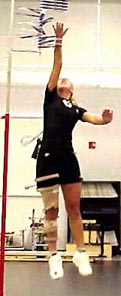 The
incidence of injury to the ACL in high school and college aged female
athletes has reached significant proportions with reports of up to an
eight-fold noncontact ACL injury occurrence compared to males. These injuries
result in considerable disability due to complicating osteoarthritis that
eventually develops in up to 80% of all individuals sustaining an ACL
injury. What is not clear is whether or not the gender-specific differences
are inherent or the result of development and/or societal influences.
As such, there is no data that suggests an appropriate age for initiating
the intervention training programs for young girls since the investigation
of developmental neuromuscular and biomechanical characteristics during
childhood has not been undertaken. The overall objective of this proposal
is to assess how the modifiable neuromuscular and biomechanical characteristics
change from childhood to adulthood in both males and females. Specifically,
the aim of this study is to determine the most effective age at which
intervention programs should be implemented in order to optimize the effectiveness
of these training programs to reduce ACL injuries. Additionally, we will
determine if training programs need to be modified based on previously
unidentified differences in neuromuscular and biomechanical characteristics
between genders at earlier ages. The results of this study will provide
valuable insight for the appropriate age for implementation of prevention
programs that can reduce the risk of disabling knee injuries.
The
incidence of injury to the ACL in high school and college aged female
athletes has reached significant proportions with reports of up to an
eight-fold noncontact ACL injury occurrence compared to males. These injuries
result in considerable disability due to complicating osteoarthritis that
eventually develops in up to 80% of all individuals sustaining an ACL
injury. What is not clear is whether or not the gender-specific differences
are inherent or the result of development and/or societal influences.
As such, there is no data that suggests an appropriate age for initiating
the intervention training programs for young girls since the investigation
of developmental neuromuscular and biomechanical characteristics during
childhood has not been undertaken. The overall objective of this proposal
is to assess how the modifiable neuromuscular and biomechanical characteristics
change from childhood to adulthood in both males and females. Specifically,
the aim of this study is to determine the most effective age at which
intervention programs should be implemented in order to optimize the effectiveness
of these training programs to reduce ACL injuries. Additionally, we will
determine if training programs need to be modified based on previously
unidentified differences in neuromuscular and biomechanical characteristics
between genders at earlier ages. The results of this study will provide
valuable insight for the appropriate age for implementation of prevention
programs that can reduce the risk of disabling knee injuries.
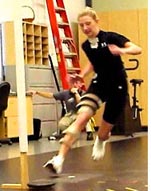 We
have previously utilized biomechanical and neuromuscular characteristics
to predict proximal anterior tibia shear force during a vertical stop-jump
task. Recent research has indicated that shear force alone may not be
capable of producing the amount of strain in the ACL that would result
in rupture of the ligament. Additional epidemiological research has indicated
that females who demonstrate a high valgus moment during a drop landing
are at greater risk for noncontact ACL injuries. The purpose of this study
is to utilize previously collected data to determine factors that predict
high valgus moments which when combined with high shear forces can increase
strain in the ACL. The results of this analysis may assist clinicians
in developing training programs designed to reduce these dangerous loading
patterns.
We
have previously utilized biomechanical and neuromuscular characteristics
to predict proximal anterior tibia shear force during a vertical stop-jump
task. Recent research has indicated that shear force alone may not be
capable of producing the amount of strain in the ACL that would result
in rupture of the ligament. Additional epidemiological research has indicated
that females who demonstrate a high valgus moment during a drop landing
are at greater risk for noncontact ACL injuries. The purpose of this study
is to utilize previously collected data to determine factors that predict
high valgus moments which when combined with high shear forces can increase
strain in the ACL. The results of this analysis may assist clinicians
in developing training programs designed to reduce these dangerous loading
patterns.