Contact us 412 624 8200
  • Home
  • Research
  • Publications
  • People
  • Teaching
  • Links

Statistical Mechanics and Thermodynamics
CHEM 2440 – Spring 2012, 2013, 2014

This course extends and elaborates the interrelated ways to look at the physical universe embodied in statistical mechanics and thermodynamics. Students start from basic principles of statistics and build up to the macroscopic consequences of atomic and molecular forces. Putting the two together allows students to understand macroscopic (i.e. observable) behavior based on molecular properties: What is heat capacity? Why does a protein folding/unfolding curve look like that? Why is a rubber-band stretchy? Where do phase transitions come from?  How do molecular collisions lead to fluctuations, diffusion, friction, viscosity, and dissipation?

Students learn how to predict the most likely configuration of a system by calculating changes in entropy; to predict the direction of spontaneous change by similar reasoning; to analyze simple engines or machines with a known equation of state to calculate quantities such as reversible work, heat flow, and efficiency; to use the mathematical techniques of thermodynamics (Legendre transformations, Maxwell relations, the cyclic rule, partial derivatives of state functions) to derive unknown
thermodynamic properties from known ones; to interpret phase diagrams;
to calculate the probability of finding a system in a certain state using the appropriate partition function; to calculate partition functions of model systems; to interpret
spectroscopic information (like a ro-vibrational spectrum) to determine macroscopic parameters (like temperature); to develop and analyze simple models of very complex systems (often based on lattices or beads); to identify the ensemble most appropriate for a given problem (e.g. microcanonical, canonical, grand canonical) and calculate
the partition function appropriate for that ensemble; to use simulations (molecular dynamics Monte Carlo simulations) to test and analyze molecular models; to calculate and interpret statistical descriptions of molecular structure and dynamics which come from molecular simulations, especially structural pair correlation functions and time correlation functions.

Thermodynamics, Statistical Mechanics, and Kinetics
CHEM 1420 – Fall 2011

This course introduces students to three distinct yet interrelated ways to look at the
physical universe. Thermodynamics is a set of empirical rules derived from many experiments. These rules, along with some sophisticated mathematical machinery, can predict the energy output of unknown chemical reactions from known ones; can predict the maximum efficiency of a heat engine -- any heat engine, regardless of
how it works!; and can predict chemical equilibria. Statistical mechanics provides a molecular scale understanding of the thermodynamic results. Using mathematical tools from statistics, one can use atomic and molecular properties to calculate thermodynamic quantities. Kinetics addresses how fast reactions happen and why. For all its power, thermodyamics only gives the infinite time limit for equilibrium. The concepts of transition states, activation energies, free energy surfaces, and rate laws, let a chemist know how to understand and optimize the rates of chemical changes.
Picture
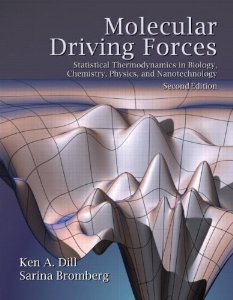
The text for CHEM 2440 gives an overview of how simple models of intermolecular interactions can build into the complex behaviors of macroscopic systems.

Picture
The laws of thermodynamics in CHEM 1420 are introduced as empirical observations of how our universe behaves, and then they are built up from the statistics of atoms and molecules.


Exploring Physical Chemistry with Mobile Devices
Picture
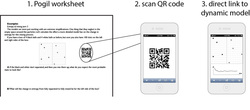
Guided inquiry methods, POGIL for example, are an effective way to introduce active learning to the science classroom. Students begin by exploring a model, construct the explanation, and then learn the standard terminology for that concept. Because students construct their own understanding first, and then learn to relate it to overarching themes, these methods have shown marked improvements in student outcomes in both introductory and advanced chemistry classrooms. Typical guided inquiry materials are worksheets, which are effective in many cases. The subject matter in physical chemistry, however, often involves inherently dynamic processes and sometimes extended pen and paper calculation to flesh out a guided inquiry model. Computer simulations integrated into guided inquiry materials could radically change the way students engage with the toughest concepts in physical chemistry. These will be ‘numerical experiments’ packaged in a guided inquiry format for my Physical Chemistry courses at the undergraduate (∼35 students) and graduate (∼15 students) levels. Electronic course materials (HTML5 applications) are being developed which will marry monte carlo, molecular dynamics, and other statistical simulations to a guided inquiry format. This project provides the following advantages for students: 1) active learning for topics difficult to visualize on the static flatland of a peice of paper; 2) materials that are broadly accessible inside and outside the classroom; 3) students get an introduction to the foundational concepts of modern theoretical chemistry (computer simulation) earlier in their chemistry careers. 

Course Roadmaps
Picture
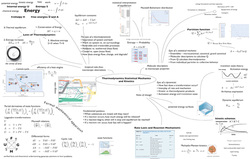
I supplement the syllabus of my courses with a course roadmap — a visual summary which introduces the content, structure, and goals of the course graphically by displaying how the topics of the course fit together. This teaching tool has been useful to me and to my students, so I would like to share how I use it, how it affects student learning, why I value it, the guiding principles for developing these instruments, and some tips on the practical issues of producing them... (read more)

Related Material

  • The POGIL program
  • The Journal of Chemical Education
  • Teaching Times (Pitt)
Create a free web site with Weebly